• Content
  • Collaboration
  • About Us
  • Contact Us

SEARCH RESULTS FOR: Signs-and-Symptoms-of-Pulmonary-Embolism

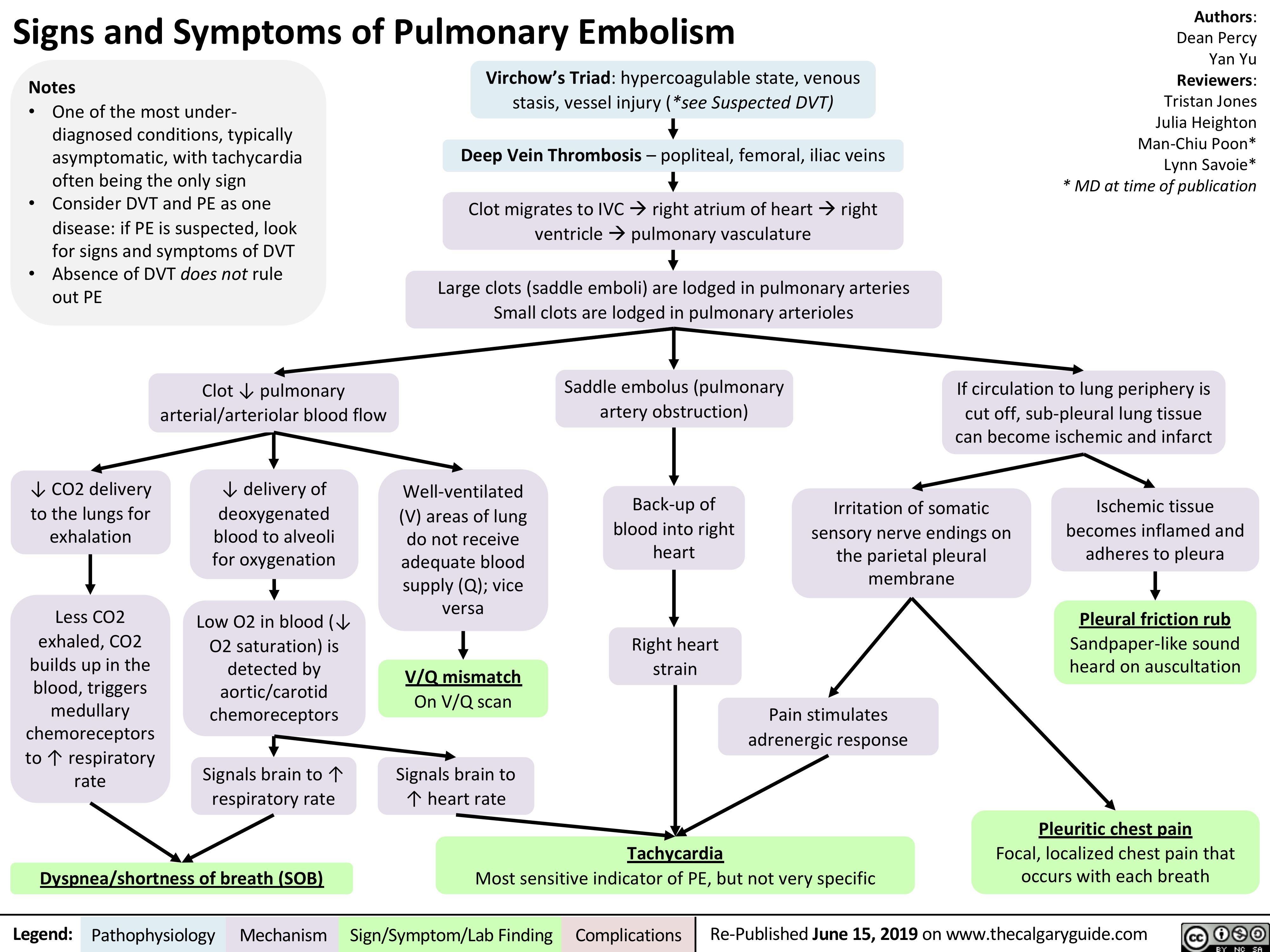
Signs and Symptoms of Pulmonary Embolism

Signs and Symptoms of Pulmonary Embolism
Authors: Dean Percy Yan Yu Reviewers: Tristan Jones Julia Heighton Man-Chiu Poon* Lynn Savoie* * MD at time of publication
  Notes
• One of the most under- diagnosed conditions, typically asymptomatic, with tachycardia often being the only sign
• Consider DVT and PE as one disease: if PE is suspected, look for signs and symptoms of DVT
• Absence of DVT does not rule out PE
Virchow’s Triad: hypercoagulable state, venous stasis, vessel injury (*see Suspected DVT)
Deep Vein Thrombosis – popliteal, femoral, iliac veins Clot migrates to IVCàright atrium of heartàright
ventricleàpulmonary vasculature
Large clots (saddle emboli) are lodged in pulmonary arteries
Small clots are lodged in pulmonary arterioles
Saddle embolus (pulmonary artery obstruction)
Back-up of blood into right heart
Right heart strain
          ↓ CO2 delivery to the lungs for exhalation
Less CO2 exhaled, CO2 builds up in the blood, triggers medullary chemoreceptors to ↑ respiratory rate
Well-ventilated (V) areas of lung do not receive adequate blood supply (Q); vice versa
V/Q mismatch
On V/Q scan
Signals brain to ↑ heart rate
Ischemic tissue becomes inflamed and adheres to pleura
Pleural friction rub
Sandpaper-like sound heard on auscultation
Pleuritic chest pain
Focal, localized chest pain that occurs with each breath
Clot ↓ pulmonary arterial/arteriolar blood flow
↓ delivery of deoxygenated blood to alveoli for oxygenation
Low O2 in blood (↓ O2 saturation) is detected by aortic/carotid chemoreceptors
Signals brain to ↑ respiratory rate
If circulation to lung periphery is cut off, sub-pleural lung tissue can become ischemic and infarct
        Irritation of somatic sensory nerve endings on the parietal pleural membrane
              Pain stimulates adrenergic response
           Tachycardia
  Dyspnea/shortness of breath (SOB)
Most sensitive indicator of PE, but not very specific
  Legend:
 Pathophysiology
 Mechanism
Sign/Symptom/Lab Finding
  Complications
Re-Published June 15, 2019 on www.thecalgaryguide.com

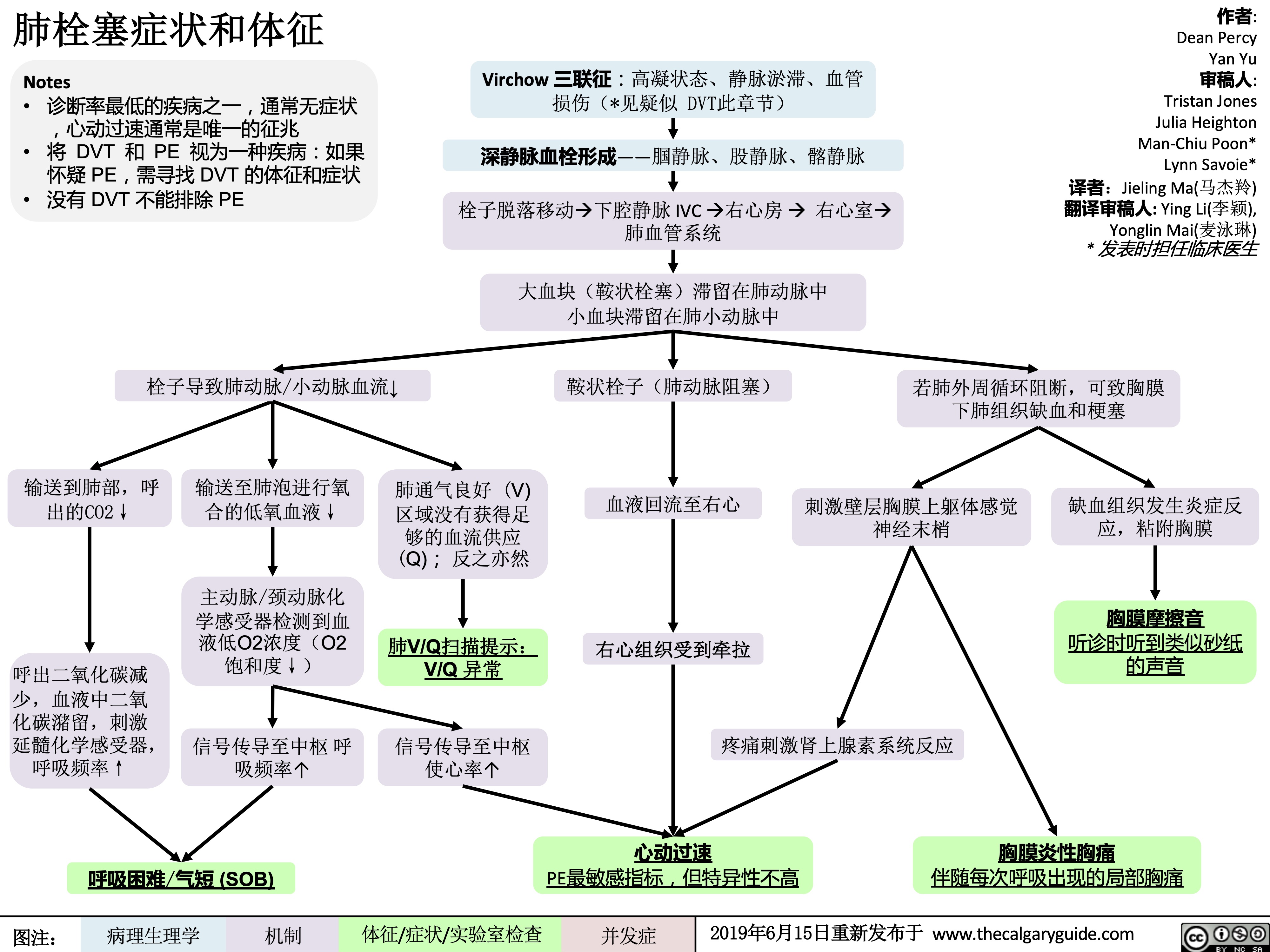
肺栓塞症状和体征

肺栓塞症状和体征
Notes
• 诊断率最低的疾病之一,通常无症状 ,心动过速通常是唯一的征兆
• 将 DVT 和 PE 视为一种疾病:如果 怀疑 PE,需寻找 DVT 的体征和症状
• 没有 DVT 不能排除 PE
Virchow 三联征:高凝状态、静脉淤滞、血管 损伤(*见疑似 DVT此章节)
深静脉血栓形成——腘静脉、股静脉、髂静脉 栓子脱落移动à下腔静脉 IVC à右心房 à 右心室à
肺血管系统
   大血块(鞍状栓塞)滞留在肺动脉中
      小血块滞留在肺小动脉中
鞍状栓子(肺动脉阻塞)
血液回流至右心
右心组织受到牵拉
作者: Dean Percy Yan Yu 审稿人: Tristan Jones Julia Heighton Man-Chiu Poon* Lynn Savoie* 译者:Jieling Ma(马杰羚) 翻译审稿人: Ying Li(李颖), Yonglin Mai(麦泳琳) * 发表时担任临床医生
若肺外周循环阻断,可致胸膜
  下肺组织缺血和梗塞
          栓子导致肺动脉/小动脉血流↓
       输送到肺部,呼 输送至肺泡进行氧
肺通气良好 (V) 区域没有获得足 够的血流供应 (Q); 反之亦然
肺V/Q扫描提示: V/Q 异常
信号传导至中枢 使心率↑
刺激壁层胸膜上躯体感觉
    神经末梢
缺血组织发生炎症反
  应,粘附胸膜
胸膜摩擦音
听诊时听到类似砂纸
   的声音
   出的CO2↓
合的低氧血液↓
主动脉/颈动脉化 学感受器检测到血 液低O2浓度(O2 饱和度↓)
信号传导至中枢 呼 吸频率↑
               呼出二氧化碳减
少,血液中二氧
化碳潴留,刺激
延髓化学感受器,
 呼吸频率↑
疼痛刺激肾上腺素系统反应
           心动过速
胸膜炎性胸痛
   呼吸困难/气短 (SOB)
PE最敏感指标,但特异性不高 伴随每次呼吸出现的局部胸痛
    图注:
 病理生理学
 机制
 体征/症状/实验室检查
 并发症
2019年6月15日重新发布于 www.thecalgaryguide.com

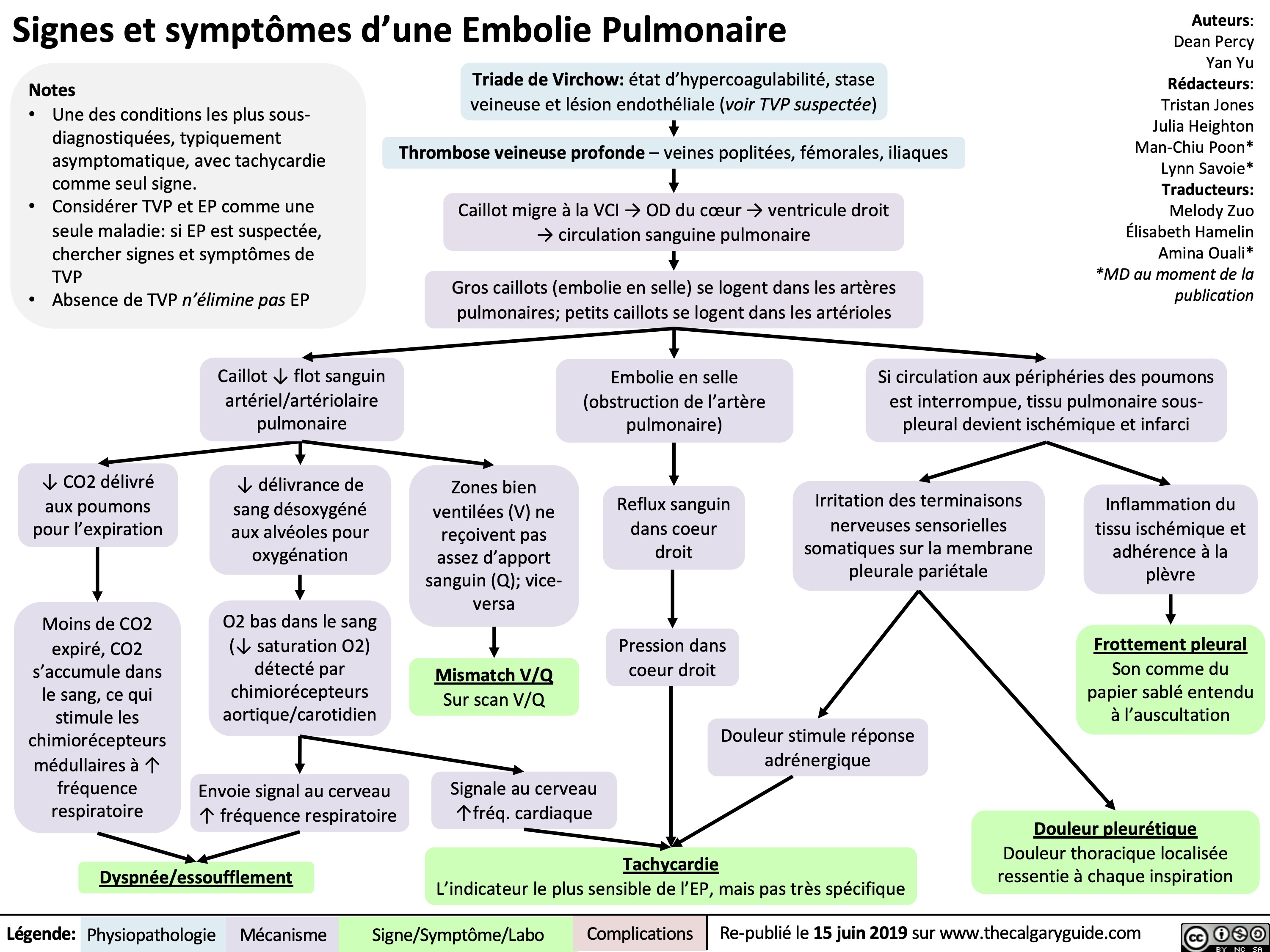
Signes et symptomes dune Embolie Pulmonaire
Signes et symptômes d’une Embolie Pulmonaire

© 2026 - The Calgary Guide to Understanding Disease

Disclaimer