SEARCH RESULTS FOR: Ventricular-Septal-Defect

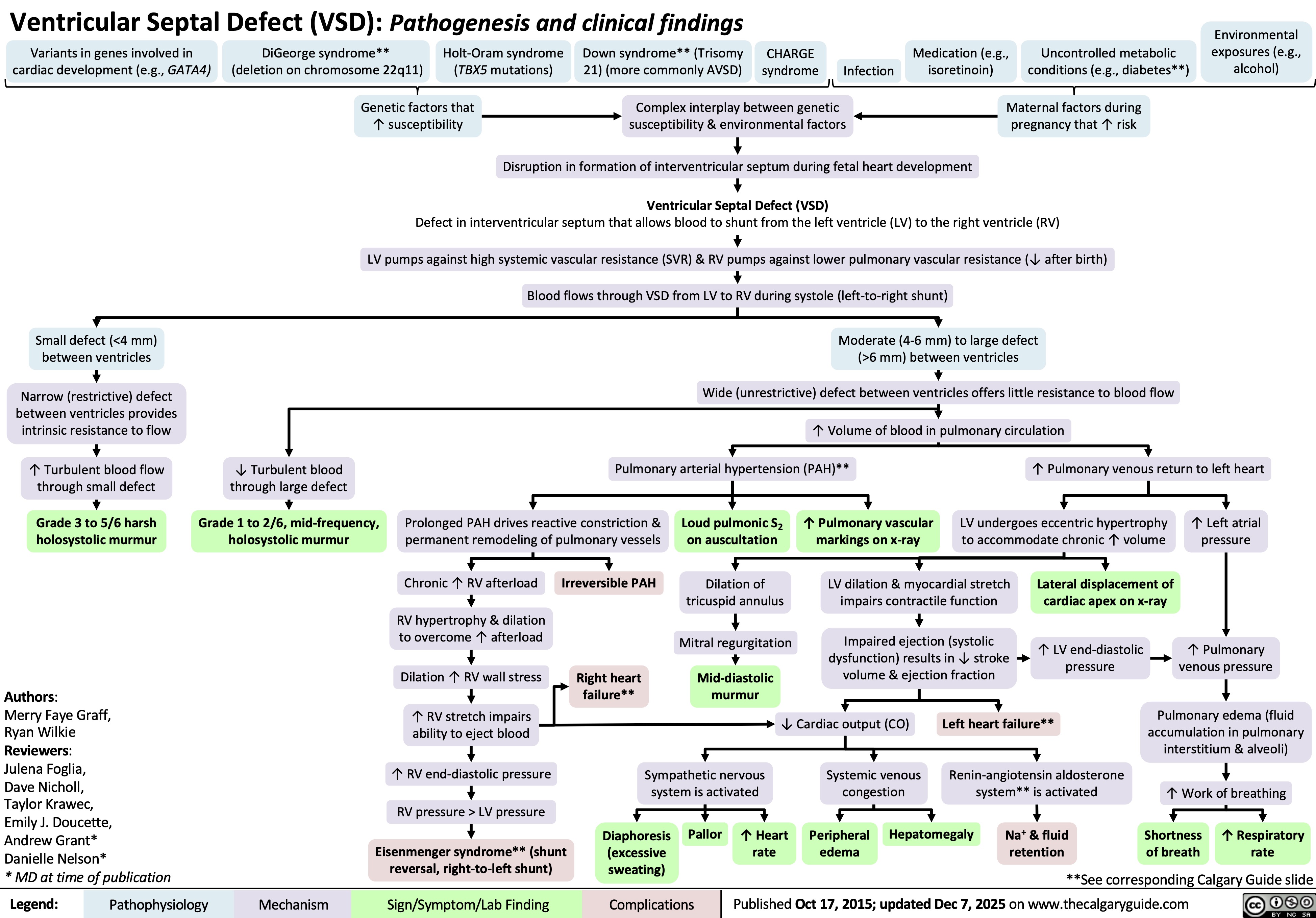
Ventricular Septal Defect
Authors:
Merry Faye Graff,
Ryan Wilkie
Reviewers:
Julena Foglia,
Dave Nicholl,
Taylor Krawec,
Emily J. Doucette,
Andrew Grant*
Danielle Nelson*
* MD at time of publication
Legend: Ventricular Septal Defect (VSD): Pathogenesis and clinical findings
Variants in genes involved in
cardiac development (e.g., GATA4)
DiGeorge syndrome**
(deletion on chromosome 22q11)
Holt-Oram syndrome
(TBX5 mutations)
Down syndrome** (Trisomy
21) (more commonly AVSD)
CHARGE
syndrome
Infection
Medication (e.g.,
isoretinoin)
Uncontrolled metabolic
conditions (e.g., diabetes**)
Environmental
exposures (e.g.,
alcohol)
Genetic factors that
↑ susceptibility
Complex interplay between genetic
susceptibility & environmental factors
Maternal factors during
pregnancy that ↑ risk
Disruption in formation of interventricular septum during fetal heart development
Ventricular Septal Defect (VSD)
Defect in interventricular septum that allows blood to shunt from the left ventricle (LV) to the right ventricle (RV)
LV pumps against high systemic vascular resistance (SVR) & RV pumps against lower pulmonary vascular resistance (↓ after birth)
Blood flows through VSD from LV to RV during systole (left-to-right shunt)
Small defect (<4 mm)
between ventricles
Moderate (4-6 mm) to large defect
(>6 mm) between ventricles
Narrow (restrictive) defect
between ventricles provides
intrinsic resistance to flow
Wide (unrestrictive) defect between ventricles offers little resistance to blood flow
↑ Volume of blood in pulmonary circulation
↑ Turbulent blood flow
through small defect
↓ Turbulent blood
through large defect
Pulmonary arterial hypertension (PAH)**
↑ Pulmonary venous return to left heart
Grade 3 to 5/6 harsh
holosystolic murmur
Grade 1 to 2/6, mid-frequency,
holosystolic murmur
Loud pulmonic S2
on auscultation
↑ Pulmonary vascular
markings on x-ray
LV undergoes eccentric hypertrophy
to accommodate chronic ↑ volume
↑ Left atrial
pressure
Dilation of
tricuspid annulus
LV dilation & myocardial stretch
impairs contractile function
Lateral displacement of
cardiac apex on x-ray
Mitral regurgitation
Impaired ejection (systolic
dysfunction) results in ↓ stroke
volume & ejection fraction
↑ LV end-diastolic
pressure
↑ Pulmonary
venous pressure
Mid-diastolic
murmur
↓ Cardiac output (CO) Left heart failure**
Pulmonary edema (fluid
accumulation in pulmonary
interstitium & alveoli)
Sympathetic nervous
system is activated
Systemic venous
congestion
Renin-angiotensin aldosterone
system** is activated
↑ Work of breathing
Diaphoresis
Pallor ↑ Heart
(excessive
rate
sweating)
Peripheral
edema
Hepatomegaly
Na+ & fluid
retention
Shortness
of breath
↑ Respiratory
rate
**See corresponding Calgary Guide slide
Complications
Published Oct 17, 2015; updated Dec 7, 2025 on www.thecalgaryguide.com
Prolonged PAH drives reactive constriction &
permanent remodeling of pulmonary vessels
Chronic ↑ RV afterload
Irreversible PAH
RV hypertrophy & dilation
to overcome ↑ afterload
Dilation ↑ RV wall stress
↑ RV stretch impairs
ability to eject blood
↑ RV end-diastolic pressure
RV pressure > LV pressure
Right heart
failure**
Eisenmenger syndrome** (shunt
reversal, right-to-left shunt)
Pathophysiology Mechanism
Sign/Symptom/Lab Finding