SEARCH RESULTS FOR: Ventricular-Fibrillation

Ventricular Fibrillation
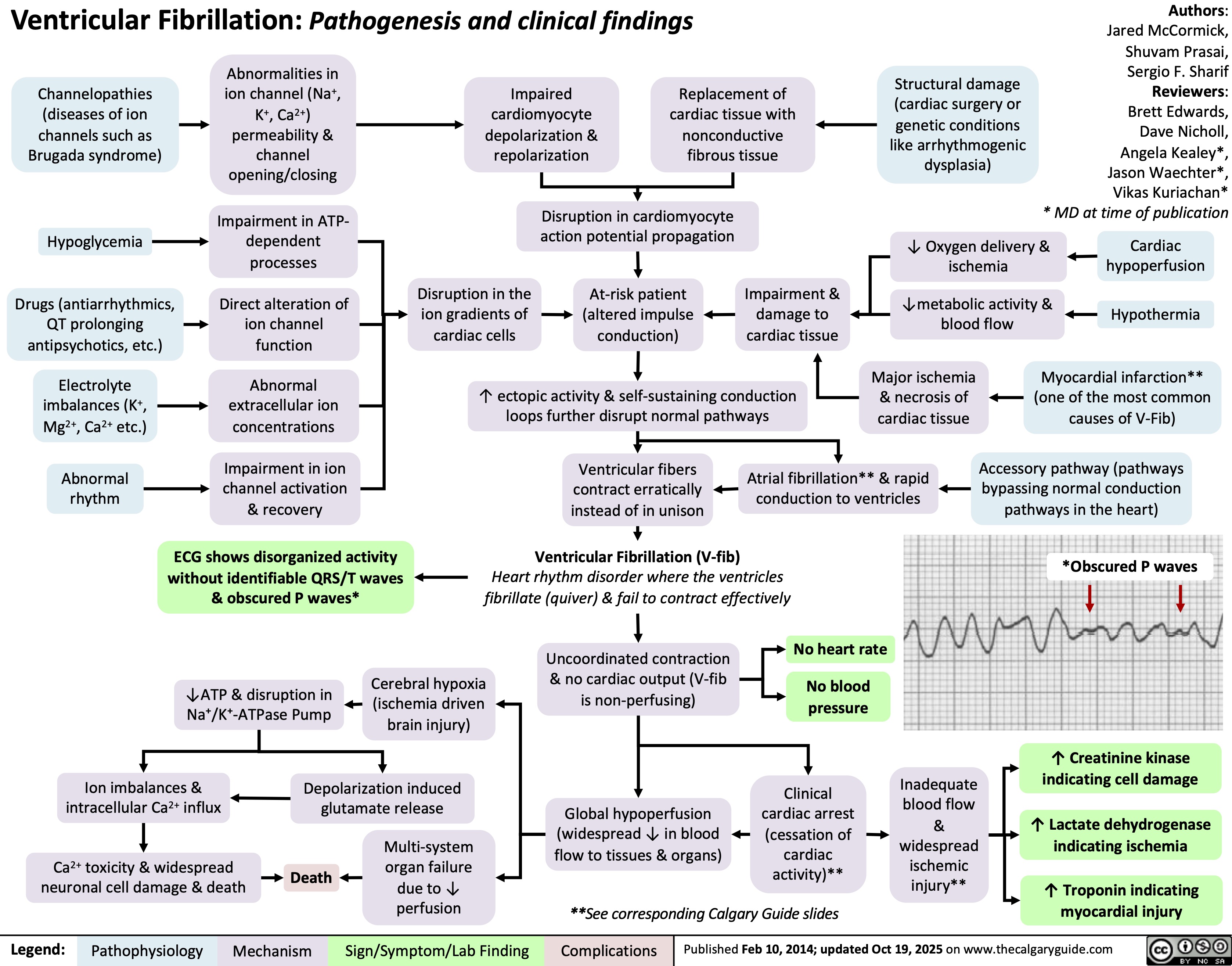
Ventricular Fibrillation: Pathogenesis and clinical findings
Channelopathies
(diseases of ion
channels such as
Brugada syndrome)
Abnormalities in
ion channel (Na+
,
K+, Ca2+)
permeability &
channel
opening/closing
Impaired
cardiomyocyte
depolarization &
repolarization
Replacement of
cardiac tissue with
nonconductive
fibrous tissue
Structural damage
(cardiac surgery or
genetic conditions
like arrhythmogenic
dysplasia)
Authors:
Jared McCormick,
Shuvam Prasai,
Sergio F. Sharif
Reviewers:
Brett Edwards,
Dave Nicholl,
Angela Kealey*,
Jason Waechter*,
Vikas Kuriachan*
* MD at time of publication
Hypoglycemia
Impairment in ATP-
dependent
processes
Disruption in cardiomyocyte
action potential propagation
↓ Oxygen delivery &
ischemia
Cardiac
hypoperfusion
Drugs (antiarrhythmics,
QT prolonging
antipsychotics, etc.)
Direct alteration of
ion channel
function
Disruption in the
ion gradients of
cardiac cells
At-risk patient
(altered impulse
conduction)
Impairment &
damage to
cardiac tissue
↓metabolic activity &
blood flow
Hypothermia
Electrolyte
imbalances (K+
,
Mg2+, Ca2+ etc.)
Abnormal
extracellular ion
concentrations
↑ ectopic activity & self-sustaining conduction
loops further disrupt normal pathways
Major ischemia
& necrosis of
cardiac tissue
Myocardial infarction**
(one of the most common
causes of V-Fib)
Abnormal
rhythm
Impairment in ion
channel activation
& recovery
Ventricular fibers
contract erratically
instead of in unison
Atrial fibrillation** & rapid
conduction to ventricles
Accessory pathway (pathways
bypassing normal conduction
pathways in the heart)
ECG shows disorganized activity
without identifiable QRS/T waves
& obscured P waves*
Ventricular Fibrillation (V-fib)
Heart rhythm disorder where the ventricles
fibrillate (quiver) & fail to contract effectively
*Obscured P waves
No heart rate
↓ATP & disruption in
Na⁺/K⁺-ATPase Pump
Cerebral hypoxia
(ischemia driven
brain injury)
Uncoordinated contraction
& no cardiac output (V-fib
is non-perfusing)
No blood
pressure
↑ Creatinine kinase
indicating cell damage
Ion imbalances &
intracellular Ca2+ influx
Depolarization induced
glutamate release
Global hypoperfusion
(widespread ↓ in blood
flow to tissues & organs)
Ca2+ toxicity & widespread
neuronal cell damage & death
Death
Multi-system
organ failure
due to ↓
perfusion
Clinical
cardiac arrest
(cessation of
cardiac
activity)**
Inadequate
blood flow
&
widespread
ischemic
injury**
↑ Lactate dehydrogenase
indicating ischemia
**See corresponding Calgary Guide slides
↑ Troponin indicating
myocardial injury
Legend: Published Feb 10, 2014; updated Oct 19, 2025 on www.thecalgaryguide.com
Pathophysiology Mechanism
Sign/Symptom/Lab Finding Complications