SEARCH RESULTS FOR: Vancomycin

Antibiotics Classes and Mechanisms

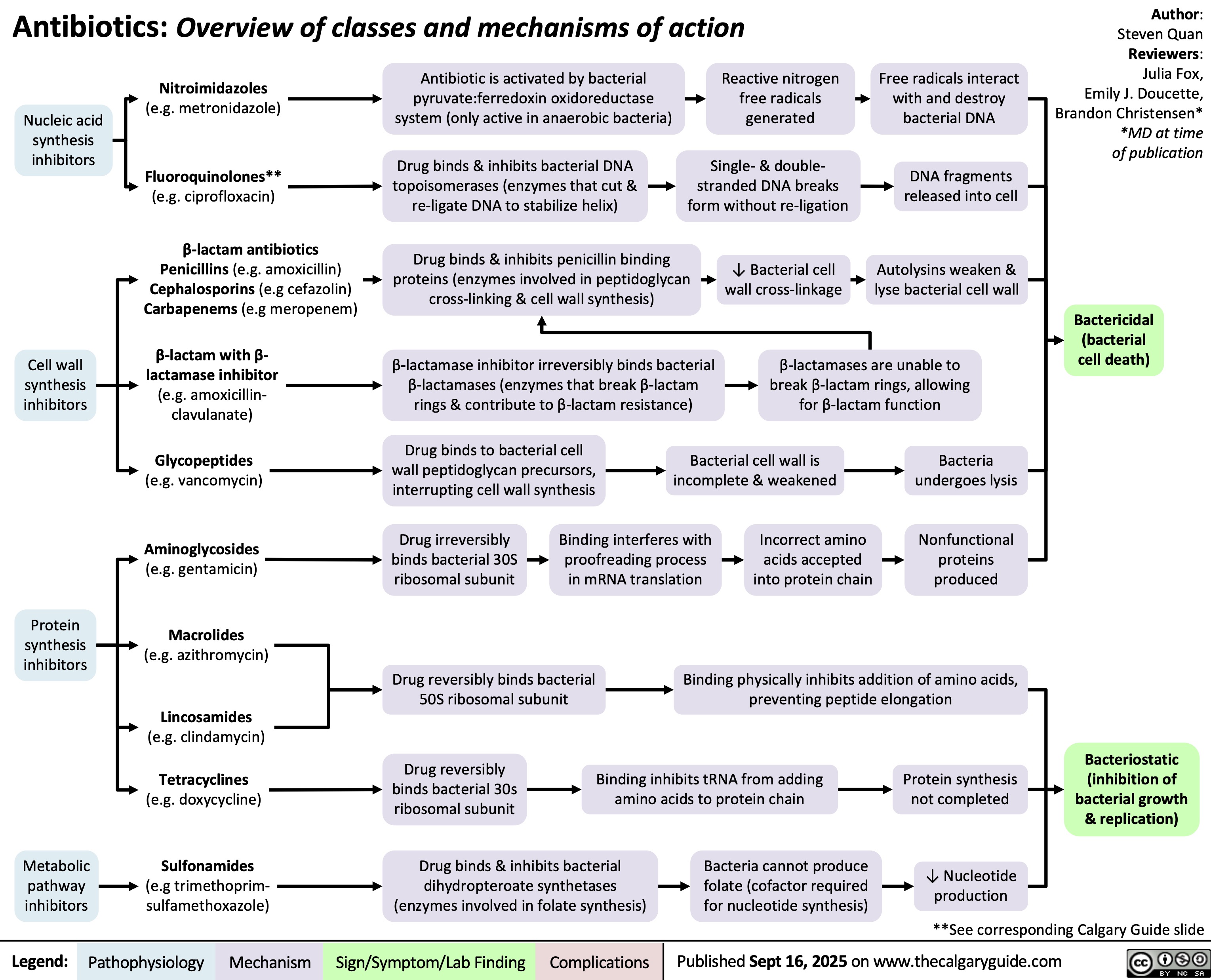
Antibiotics: Overview of classes and mechanisms of action
Nucleic acid
synthesis
inhibitors
Cell wall
synthesis
inhibitors
Protein
synthesis
inhibitors
Nitroimidazoles
(e.g. metronidazole)
Antibiotic is activated by bacterial
pyruvate:ferredoxin oxidoreductase
system (only active in anaerobic bacteria)
Fluoroquinolones**
(e.g. ciprofloxacin)
Drug binds & inhibits bacterial DNA
topoisomerases (enzymes that cut &
re-ligate DNA to stabilize helix)
β-lactam antibiotics
Penicillins (e.g. amoxicillin)
Cephalosporins (e.g cefazolin)
Carbapenems (e.g meropenem)
Drug binds & inhibits penicillin binding
proteins (enzymes involved in peptidoglycan
cross-linking & cell wall synthesis)
β-lactam with β-
lactamase inhibitor
(e.g. amoxicillin-
clavulanate)
β-lactamase inhibitor irreversibly binds bacterial
β-lactamases (enzymes that break β-lactam
rings & contribute to β-lactam resistance)
Glycopeptides
(e.g. vancomycin)
Drug binds to bacterial cell
wall peptidoglycan precursors,
interrupting cell wall synthesis
Aminoglycosides
(e.g. gentamicin)
Drug irreversibly
binds bacterial 30S
ribosomal subunit
Binding interferes with
proofreading process
in mRNA translation
Macrolides
(e.g. azithromycin)
Lincosamides
(e.g. clindamycin)
Tetracyclines
(e.g. doxycycline)
Sulfonamides
(e.g trimethoprim-
sulfamethoxazole)
Reactive nitrogen
free radicals
generated
Single- & double-
stranded DNA breaks
form without re-ligation
↓ Bacterial cell
wall cross-linkage
Free radicals interact
with and destroy
bacterial DNA
DNA fragments
released into cell
Autolysins weaken &
lyse bacterial cell wall
Author:
Steven Quan
Reviewers:
Julia Fox,
Emily J. Doucette,
Brandon Christensen*
*MD at time
of publication
Bactericidal
(bacterial
cell death)
β-lactamases are unable to
break β-lactam rings, allowing
for β-lactam function
Bacterial cell wall is
incomplete & weakened
Incorrect amino
acids accepted
into protein chain
Bacteria
undergoes lysis
Nonfunctional
proteins
produced
Metabolic
pathway
inhibitors
Legend: Pathophysiology Mechanism
Sign/Symptom/Lab Finding Drug reversibly binds bacterial
50S ribosomal subunit
Drug reversibly
binds bacterial 30s
ribosomal subunit
Drug binds & inhibits bacterial
dihydropteroate synthetases
(enzymes involved in folate synthesis)
Complications
Binding physically inhibits addition of amino acids,
preventing peptide elongation
Binding inhibits tRNA from adding
amino acids to protein chain
Bacteria cannot produce
folate (cofactor required
for nucleotide synthesis)
Protein synthesis
not completed
↓ Nucleotide
production
Bacteriostatic
(inhibition of
bacterial growth
& replication)
**See corresponding Calgary Guide slide
Published Sept 16, 2025 on www.thecalgaryguide.com

Vancomycin

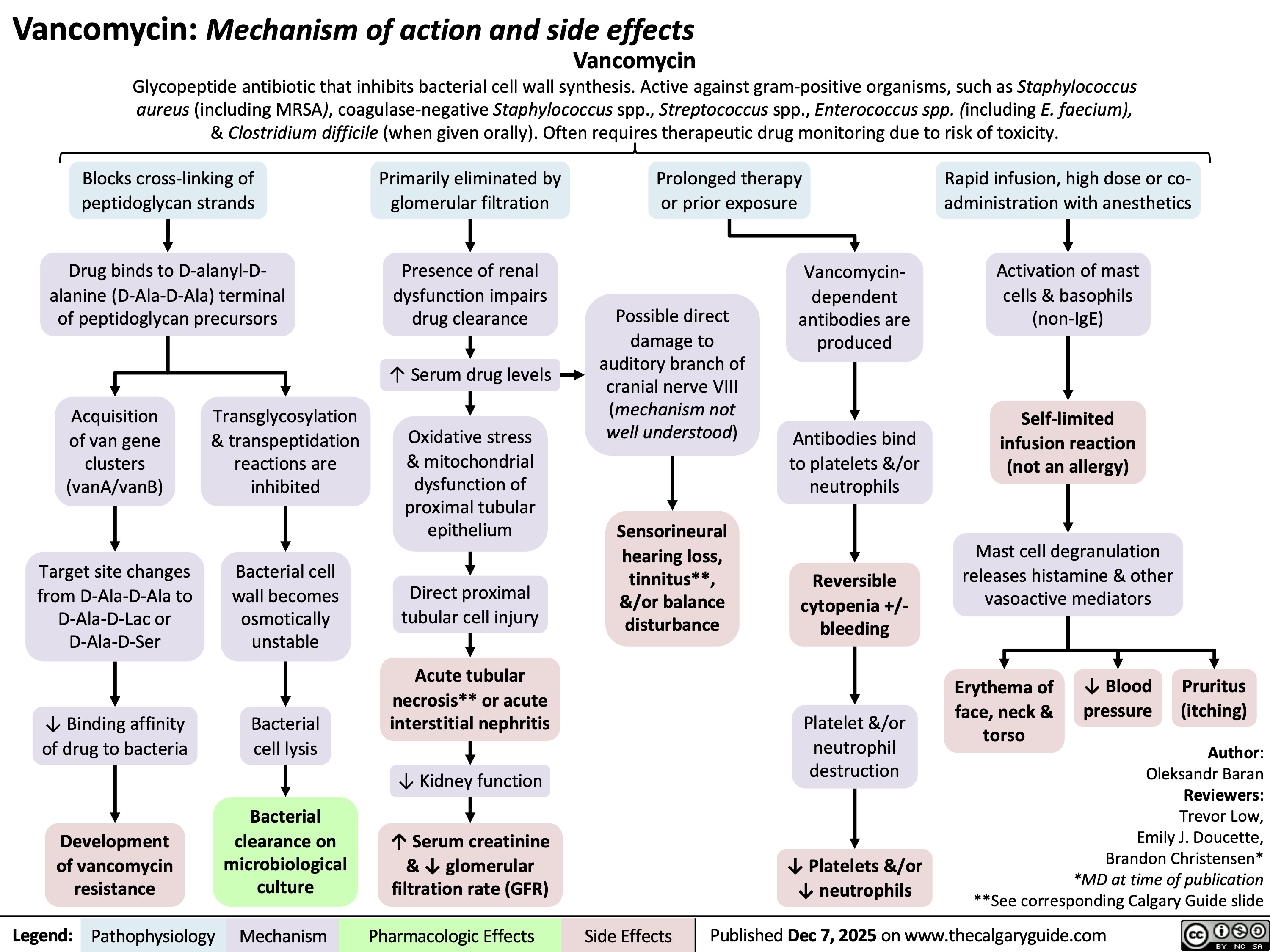
Vancomycin: Mechanism of action and side effects
Vancomycin
Glycopeptide antibiotic that inhibits bacterial cell wall synthesis. Active against gram-positive organisms, such as Staphylococcus
aureus (including MRSA), coagulase-negative Staphylococcus spp., Streptococcus spp., Enterococcus spp. (including E. faecium),
& Clostridium difficile (when given orally). Often requires therapeutic drug monitoring due to risk of toxicity.
Blocks cross-linking of
peptidoglycan strands
Drug binds to D-alanyl-D-
alanine (D-Ala-D-Ala) terminal
of peptidoglycan precursors
Acquisition
of van gene
clusters
(vanA/vanB)
Transglycosylation
& transpeptidation
reactions are
inhibited
Target site changes
from D-Ala-D-Ala to
D-Ala-D-Lac or
D-Ala-D-Ser
Bacterial cell
wall becomes
osmotically
unstable
↓ Binding affinity
of drug to bacteria
Bacterial
cell lysis
Development
of vancomycin
resistance
Bacterial
clearance on
microbiological
culture
Legend: Primarily eliminated by
glomerular filtration
Presence of renal
dysfunction impairs
drug clearance
↑ Serum drug levels
Oxidative stress
& mitochondrial
dysfunction of
proximal tubular
epithelium
Direct proximal
tubular cell injury
Acute tubular
necrosis** or acute
interstitial nephritis
↓ Kidney function
↑ Serum creatinine
& ↓ glomerular
filtration rate (GFR)
Prolonged therapy
or prior exposure
Rapid infusion, high dose or co-
administration with anesthetics
Possible direct
damage to
auditory branch of
cranial nerve VIII
(mechanism not
well understood)
Sensorineural
hearing loss,
tinnitus**,
&/or balance
disturbance
Vancomycin-
dependent
antibodies are
produced
Antibodies bind
to platelets &/or
neutrophils
Reversible
cytopenia +/-
bleeding
Platelet &/or
neutrophil
destruction
↓ Platelets &/or
↓ neutrophils
Activation of mast
cells & basophils
(non-IgE)
Self-limited
infusion reaction
(not an allergy)
Mast cell degranulation
releases histamine & other
vasoactive mediators
Erythema of
face, neck &
torso
↓ Blood
pressure
Pruritus
(itching)
Author:
Oleksandr Baran
Reviewers:
Trevor Low,
Emily J. Doucette,
Brandon Christensen*
*MD at time of publication
**See corresponding Calgary Guide slide
Published Dec 7, 2025 on www.thecalgaryguide.com
Pathophysiology Mechanism
Pharmacologic Effects Side Effects