SEARCH RESULTS FOR: Trigger-Finger

Trigger Finger

Trigger Finger
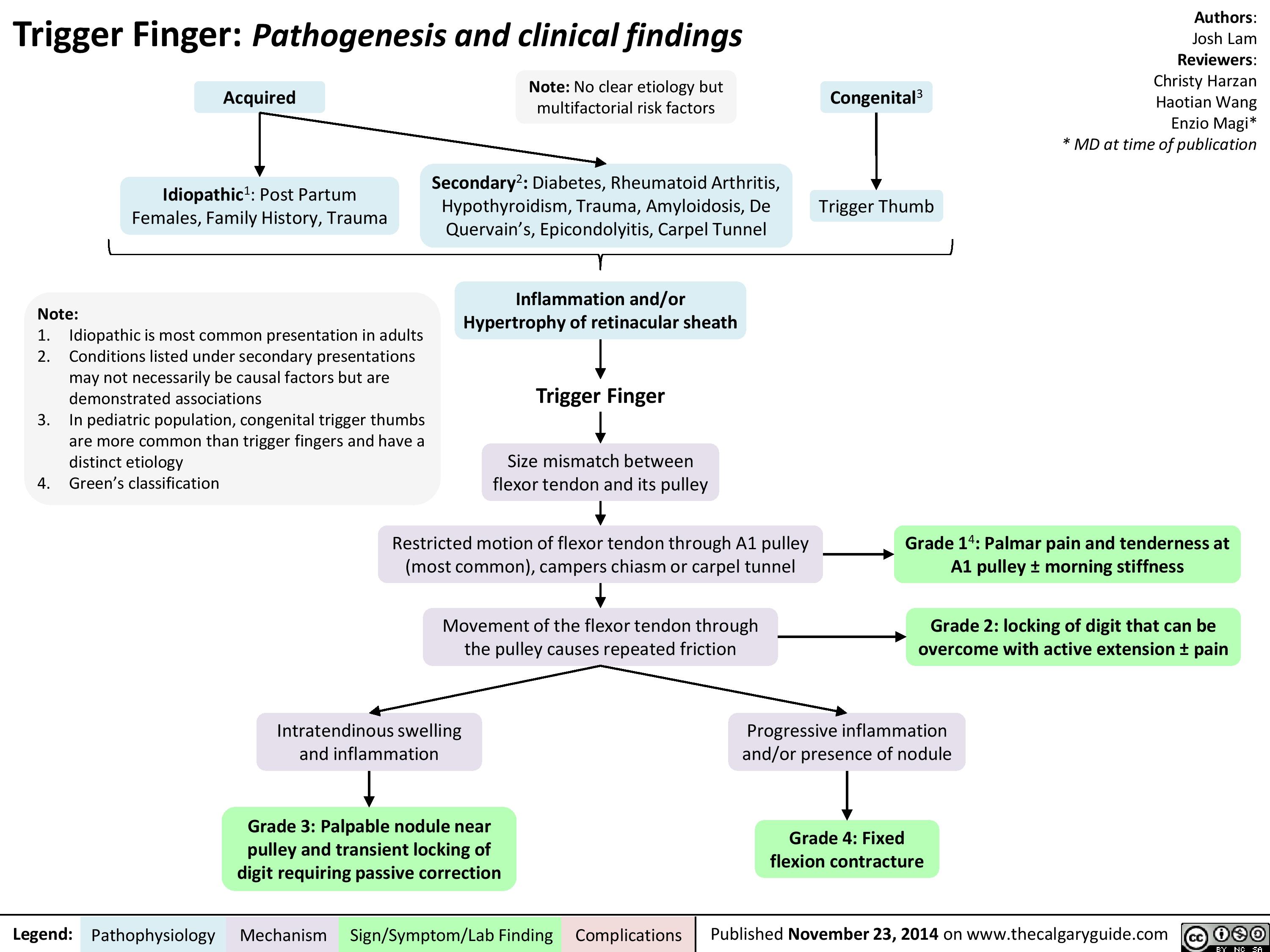
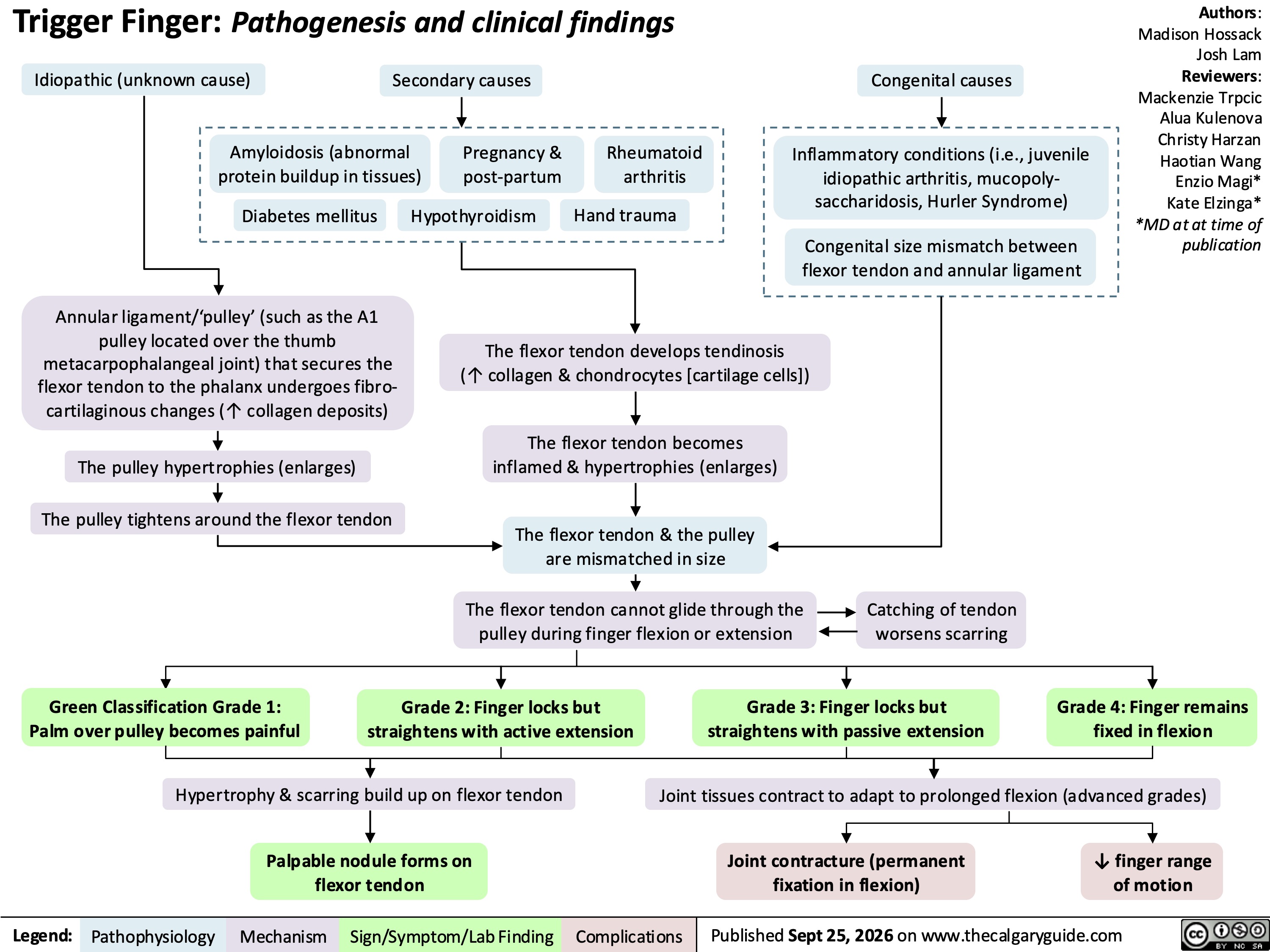
Trigger Finger: Pathogenesis and clinical findings
Idiopathic (unknown cause)
Secondary causes
Congenital causes
Amyloidosis (abnormal
protein buildup in tissues)
Pregnancy &
post-partum
Rheumatoid
arthritis
Diabetes mellitus Hypothyroidism Hand trauma
Inflammatory conditions (i.e., juvenile
idiopathic arthritis, mucopoly-
saccharidosis, Hurler Syndrome)
Congenital size mismatch between
flexor tendon and annular ligament
Authors:
Madison Hossack
Josh Lam
Reviewers:
Mackenzie Trpcic
Alua Kulenova
Christy Harzan
Haotian Wang
Enzio Magi*
Kate Elzinga*
*MD at at time of
publication
Annular ligament/‘pulley’ (such as the A1
pulley located over the thumb
metacarpophalangeal joint) that secures the
flexor tendon to the phalanx undergoes fibro-
cartilaginous changes (↑ collagen deposits)
The pulley hypertrophies (enlarges)
The pulley tightens around the flexor tendon
The flexor tendon develops tendinosis
(↑ collagen & chondrocytes [cartilage cells])
The flexor tendon becomes
inflamed & hypertrophies (enlarges)
The flexor tendon & the pulley
are mismatched in size
The flexor tendon cannot glide through the
pulley during finger flexion or extension
Catching of tendon
worsens scarring
Green Classification Grade 1:
Palm over pulley becomes painful
Grade 2: Finger locks but
straightens with active extension
Grade 3: Finger locks but
straightens with passive extension
Grade 4: Finger remains
fixed in flexion
Hypertrophy & scarring build up on flexor tendon
Palpable nodule forms on
flexor tendon
Joint tissues contract to adapt to prolonged flexion (advanced grades)
Joint contracture (permanent
fixation in flexion)
↓ finger range
of motion
Legend: Pathophysiology Mechanism
Sign/Symptom/Lab Finding Complications
Published Sept 25, 2026 on www.thecalgaryguide.com
Creative
Commons