SEARCH RESULTS FOR: Tricyclic-Antidepressants

Tricyclic Antidepressants
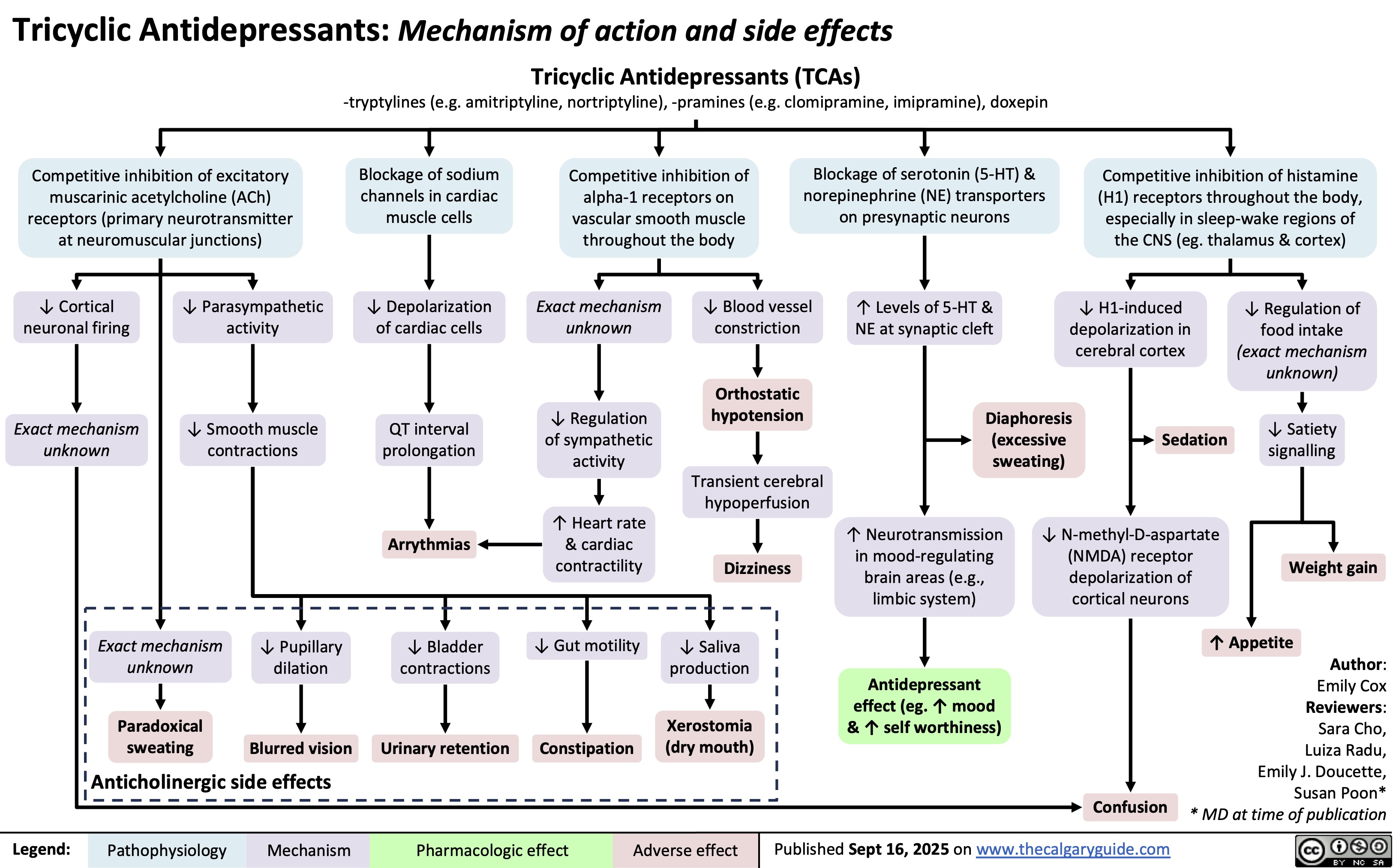
Tricyclic Antidepressants: Mechanism of action and side effects
Tricyclic Antidepressants (TCAs)
-tryptylines (e.g. amitriptyline, nortriptyline), -pramines (e.g. clomipramine, imipramine), doxepin
Competitive inhibition of excitatory
muscarinic acetylcholine (ACh)
receptors (primary neurotransmitter
at neuromuscular junctions)
Blockage of sodium
channels in cardiac
muscle cells
↓ Cortical
neuronal firing
↓ Parasympathetic
activity
↓ Depolarization
of cardiac cells
Exact mechanism
unknown
↓ Smooth muscle
contractions
QT interval
prolongation
Arrythmias
↓ Bladder
contractions
Urinary retention
Competitive inhibition of
alpha-1 receptors on
vascular smooth muscle
throughout the body
Blockage of serotonin (5-HT) &
norepinephrine (NE) transporters
on presynaptic neurons
Competitive inhibition of histamine
(H1) receptors throughout the body,
especially in sleep-wake regions of
the CNS (eg. thalamus & cortex)
Exact mechanism
unknown
↓ Blood vessel
constriction
Orthostatic
hypotension
↓ Regulation
of sympathetic
activity
Transient cerebral
hypoperfusion
↑ Heart rate
& cardiac
contractility
Dizziness
↓ Gut motility
↓ Saliva
production
Constipation
Xerostomia
(dry mouth)
↑ Levels of 5-HT &
NE at synaptic cleft
↓ H1-induced
depolarization in
cerebral cortex
↓ Regulation of
food intake
(exact mechanism
unknown)
Diaphoresis
(excessive
sweating)
Sedation ↓ Satiety
signalling
↑ Neurotransmission
in mood-regulating
brain areas (e.g.,
limbic system)
↓ N-methyl-D-aspartate
(NMDA) receptor
depolarization of
cortical neurons
Weight gain
↑ Appetite
Antidepressant
effect (eg. ↑ mood
& ↑ self worthiness)
Author:
Emily Cox
Reviewers:
Sara Cho,
Luiza Radu,
Emily J. Doucette,
Susan Poon*
Confusion
* MD at time of publication
Published Sept 16, 2025 on www.thecalgaryguide.com
Legend: Exact mechanism
unknown
↓ Pupillary
dilation
Paradoxical
sweating
Blurred vision
Anticholinergic side effects
Pathophysiology Mechanism
Pharmacologic effect Adverse effect