SEARCH RESULTS FOR: Teen-Brain-Changes

Teen Brain Changes
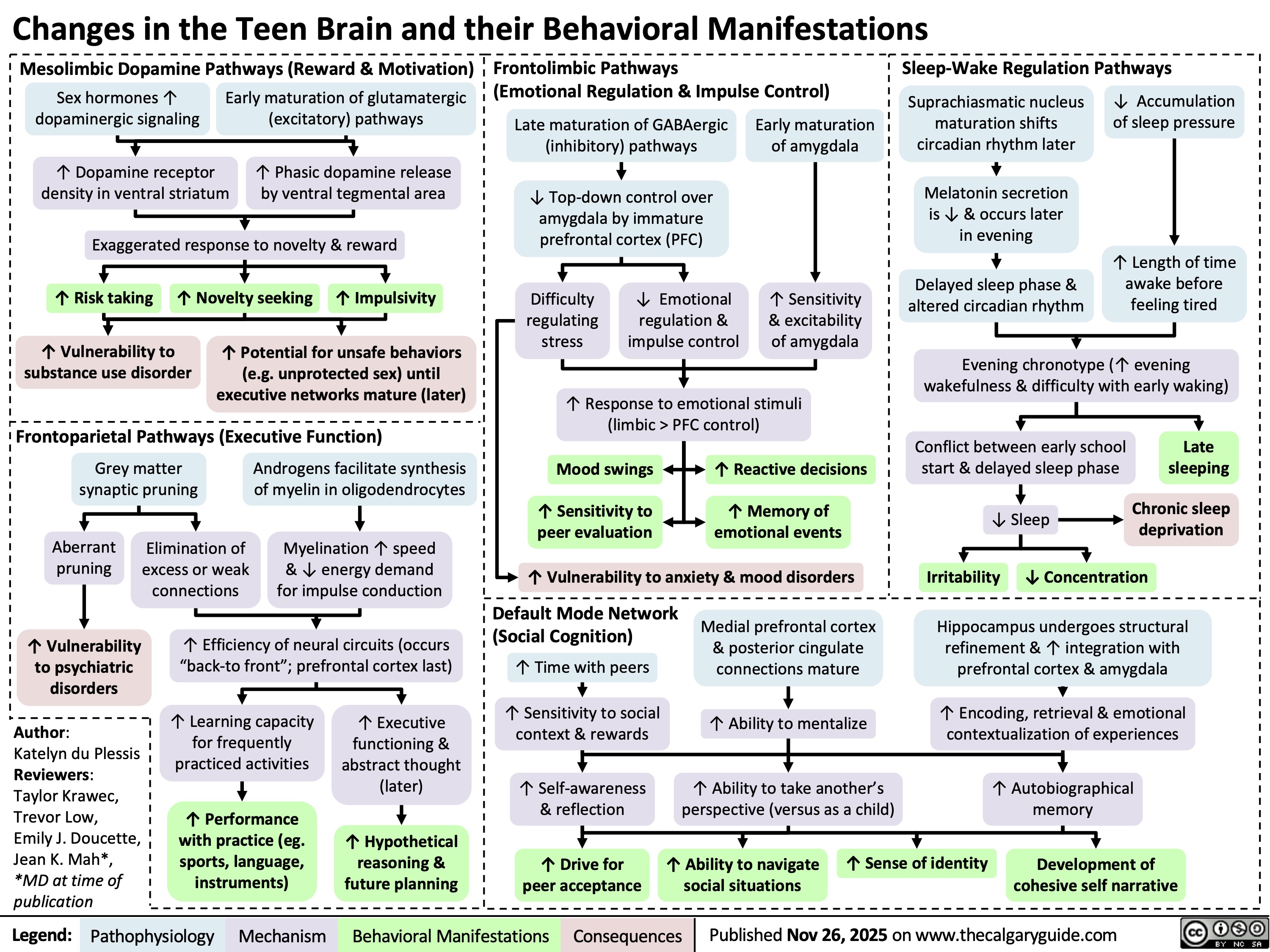
Changes in the Teen Brain and their Behavioral Manifestations
Mesolimbic Dopamine Pathways (Reward & Motivation)
Sex hormones ↑
Early maturation of glutamatergic
dopaminergic signaling
(excitatory) pathways
↑ Dopamine receptor
density in ventral striatum
↑ Phasic dopamine release
by ventral tegmental area
Exaggerated response to novelty & reward
↑ Risk taking ↑ Impulsivity
↑ Novelty seeking
↑ Vulnerability to
substance use disorder
↑ Potential for unsafe behaviors
(e.g. unprotected sex) until
executive networks mature (later)
Frontolimbic Pathways
(Emotional Regulation & Impulse Control)
Late maturation of GABAergic
(inhibitory) pathways
Early maturation
of amygdala
↓ Top-down control over
amygdala by immature
prefrontal cortex (PFC)
Difficulty
regulating
stress
↓ Emotional
regulation &
impulse control
↑ Sensitivity
& excitability
of amygdala
↑ Response to emotional stimuli
(limbic > PFC control)
Mood swings
↑ Reactive decisions
↑ Sensitivity to
peer evaluation
↑ Memory of
emotional events
↑ Vulnerability to anxiety & mood disorders
Sleep-Wake Regulation Pathways
Suprachiasmatic nucleus
maturation shifts
circadian rhythm later
↓ Accumulation
of sleep pressure
Melatonin secretion
is ↓ & occurs later
in evening
Delayed sleep phase &
altered circadian rhythm
↑ Length of time
awake before
feeling tired
Evening chronotype (↑ evening
wakefulness & difficulty with early waking)
Conflict between early school
start & delayed sleep phase
Late
sleeping
↓ Sleep
Chronic sleep
deprivation
Irritability ↓ Concentration
Frontoparietal Pathways (Executive Function)
Grey matter
synaptic pruning
Androgens facilitate synthesis
of myelin in oligodendrocytes
Aberrant
pruning
Elimination of
excess or weak
connections
Myelination ↑ speed
& ↓ energy demand
for impulse conduction
↑ Vulnerability
to psychiatric
disorders
↑ Efficiency of neural circuits (occurs
“back-to front”; prefrontal cortex last)
↑ Learning capacity
for frequently
practiced activities
↑ Executive
functioning &
abstract thought
(later)
↑ Performance
with practice (eg.
sports, language,
instruments)
↑ Hypothetical
reasoning &
future planning
Author:
Katelyn du Plessis
Reviewers:
Taylor Krawec,
Trevor Low,
Emily J. Doucette,
Jean K. Mah*,
*MD at time of
publication
Legend: Default Mode Network
(Social Cognition)
↑ Time with peers
↑ Sensitivity to social
context & rewards
↑ Self-awareness
& reflection
↑ Drive for
peer acceptance
Medial prefrontal cortex
& posterior cingulate
connections mature
↑ Ability to mentalize
↑ Ability to take another’s
perspective (versus as a child)
↑ Ability to navigate
social situations
↑ Sense of identity
Hippocampus undergoes structural
refinement & ↑ integration with
prefrontal cortex & amygdala
↑ Encoding, retrieval & emotional
contextualization of experiences
↑ Autobiographical
memory
Development of
cohesive self narrative
Pathophysiology Mechanism
Behavioral Manifestations Consequences
Published Nov 26, 2025 on www.thecalgaryguide.com