SEARCH RESULTS FOR: Suppurative-Tenosynovitis

Suppurative Tenosynovitis
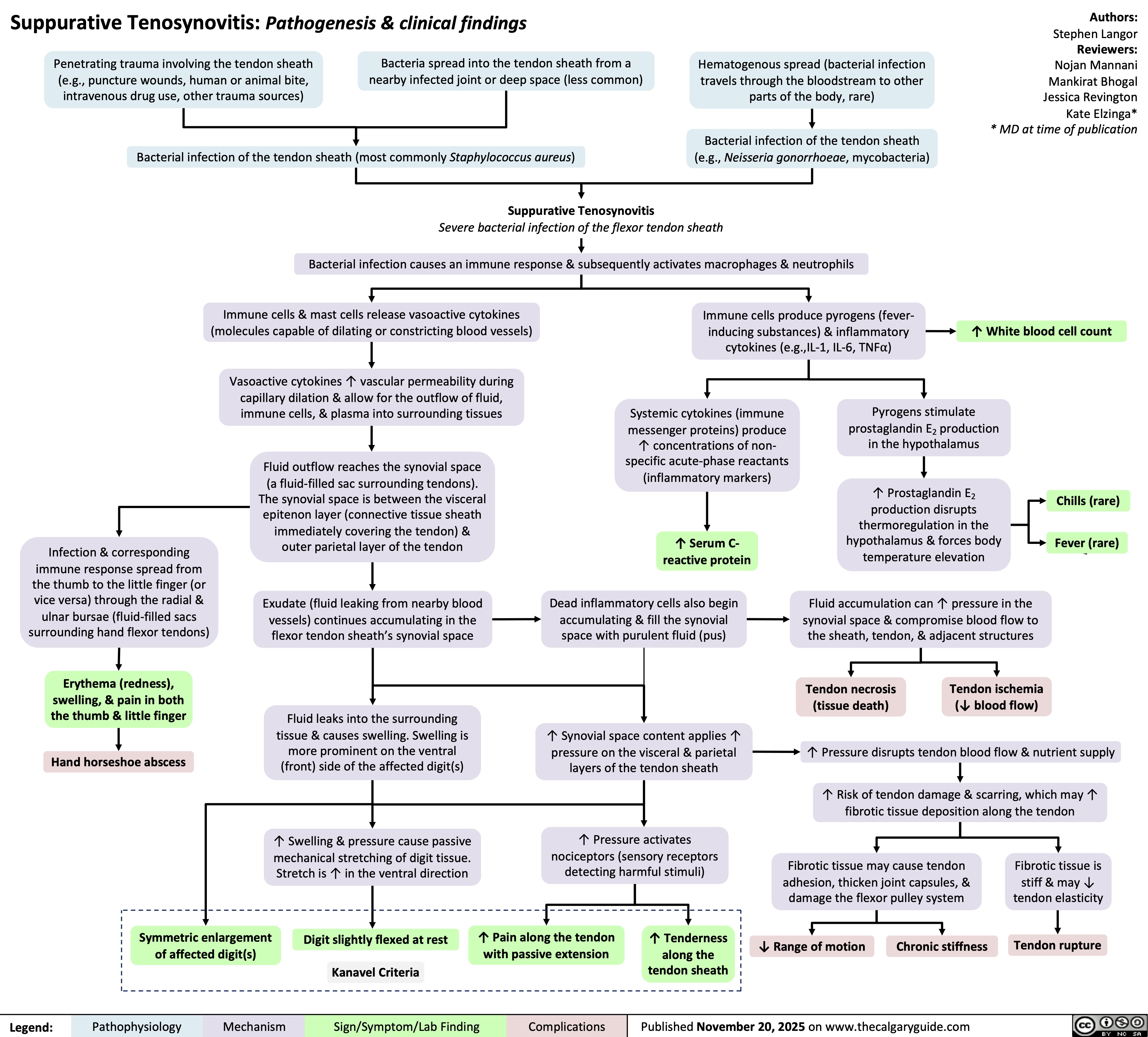
Legend: Suppurative Tenosynovitis: Pathogenesis & clinical findings
Penetrating trauma involving the tendon sheath
(e.g., puncture wounds, human or animal bite,
intravenous drug use, other trauma sources)
Bacteria spread into the tendon sheath from a
nearby infected joint or deep space (less common)
Hematogenous spread (bacterial infection
travels through the bloodstream to other
parts of the body, rare)
Authors:
Stephen Langor
Reviewers:
Nojan Mannani
Mankirat Bhogal
Jessica Revington
Kate Elzinga*
* MD at time of publication
Bacterial infection of the tendon sheath (most commonly Staphylococcus aureus)
Bacterial infection of the tendon sheath
(e.g., Neisseria gonorrhoeae, mycobacteria)
Suppurative Tenosynovitis
Severe bacterial infection of the flexor tendon sheath
Bacterial infection causes an immune response & subsequently activates macrophages & neutrophils
Immune cells & mast cells release vasoactive cytokines
(molecules capable of dilating or constricting blood vessels)
Immune cells produce pyrogens (fever-
inducing substances) & inflammatory
cytokines (e.g.,IL-1, IL-6, TNF⍺)
↑ White blood cell count
Vasoactive cytokines ↑ vascular permeability during
capillary dilation & allow for the outflow of fluid,
immune cells, & plasma into surrounding tissues
Systemic cytokines (immune
messenger proteins) produce
↑ concentrations of non-
specific acute-phase reactants
(inflammatory markers)
Pyrogens stimulate
prostaglandin E2 production
in the hypothalamus
Fluid outflow reaches the synovial space
(a fluid-filled sac surrounding tendons).
The synovial space is between the visceral
epitenon layer (connective tissue sheath
immediately covering the tendon) &
outer parietal layer of the tendon
Infection & corresponding
immune response spread from
the thumb to the little finger (or
vice versa) through the radial &
ulnar bursae (fluid-filled sacs
surrounding hand flexor tendons)
↑ Serum C-
reactive protein
↑ Prostaglandin E2
production disrupts
thermoregulation in the
hypothalamus & forces body
temperature elevation
Chills (rare)
Fever (rare)
Exudate (fluid leaking from nearby blood
vessels) continues accumulating in the
flexor tendon sheath’s synovial space
Dead inflammatory cells also begin
accumulating & fill the synovial
space with purulent fluid (pus)
Fluid accumulation can ↑ pressure in the
synovial space & compromise blood flow to
the sheath, tendon, & adjacent structures
Erythema (redness),
swelling, & pain in both
the thumb & little finger
Tendon necrosis
(tissue death)
Tendon ischemia
(↓ blood flow)
Hand horseshoe abscess
Fluid leaks into the surrounding
tissue & causes swelling. Swelling is
more prominent on the ventral
(front) side of the affected digit(s)
↑ Synovial space content applies ↑
pressure on the visceral & parietal
layers of the tendon sheath
↑ Pressure disrupts tendon blood flow & nutrient supply
↑ Risk of tendon damage & scarring, which may ↑
fibrotic tissue deposition along the tendon
↑ Swelling & pressure cause passive
mechanical stretching of digit tissue.
Stretch is ↑ in the ventral direction ↑ Pressure activates
nociceptors (sensory receptors
detecting harmful stimuli)
Fibrotic tissue may cause tendon
adhesion, thicken joint capsules, &
damage the flexor pulley system
Fibrotic tissue is
stiff & may ↓
tendon elasticity
Symmetric enlargement
of affected digit(s)
Digit slightly flexed at rest
↑ Pain along the tendon
with passive extension
Kanavel Criteria
↑ Tenderness
along the
tendon sheath
↓ Range of motion
Chronic stiffness
Tendon rupture
Published November 20, 2025 on www.thecalgaryguide.com
Pathophysiology Mechanism
Sign/Symptom/Lab Finding Complications