SEARCH RESULTS FOR: Subtrochanteric-Femur-Fracture

Subtrochanteric Femur Fracture
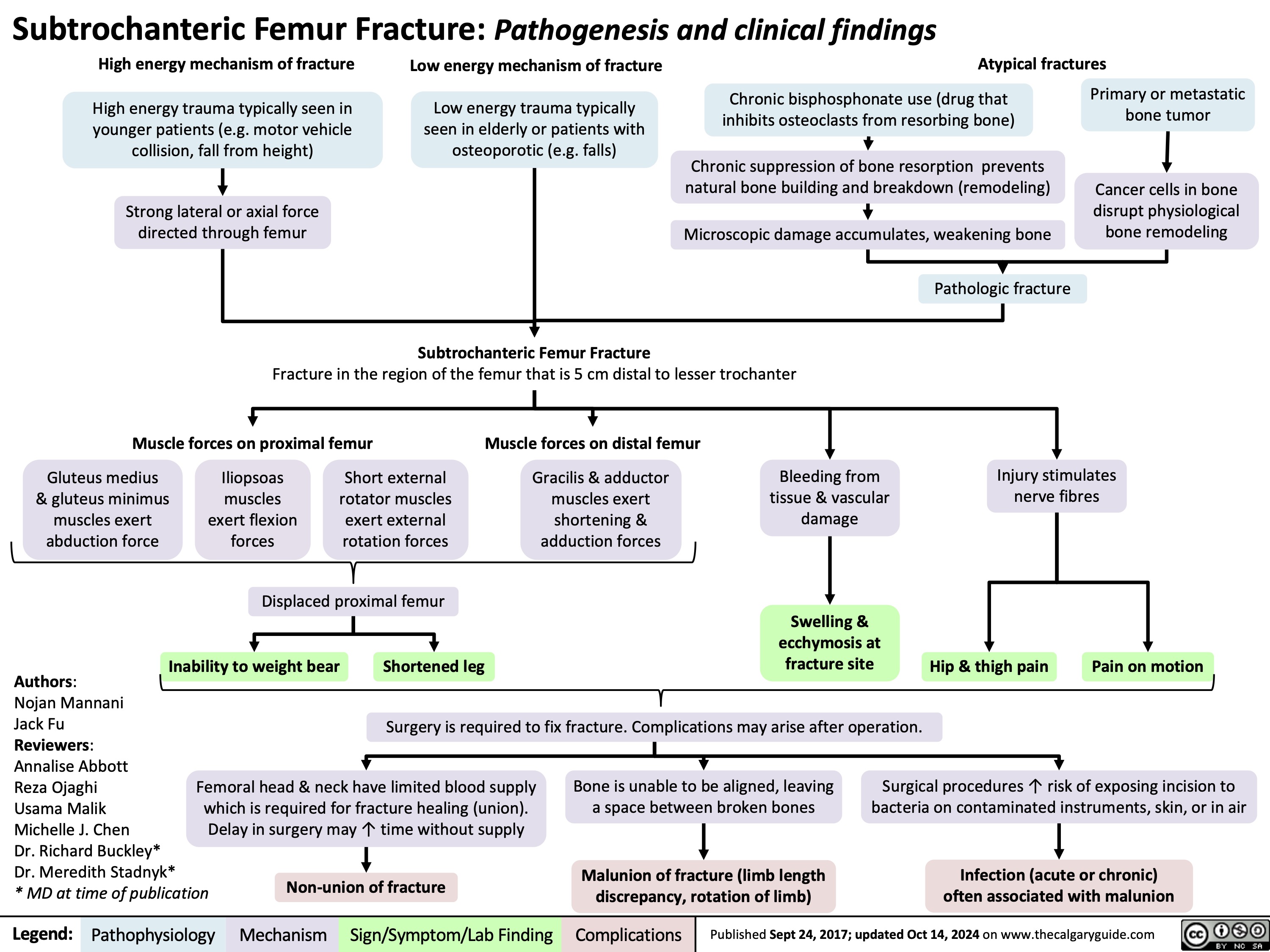
Subtrochanteric Femur Fracture: Pathogenesis and clinical findings
High energy mechanism of fracture
High energy trauma typically seen in younger patients (e.g. motor vehicle collision, fall from height)
Strong lateral or axial force directed through femur
Low energy mechanism of fracture
Low energy trauma typically seen in elderly or patients with osteoporotic (e.g. falls)
Atypical fractures
  Chronic bisphosphonate use (drug that inhibits osteoclasts from resorbing bone)
Chronic suppression of bone resorption prevents natural bone building and breakdown (remodeling)
Microscopic damage accumulates, weakening bone Pathologic fracture
Primary or metastatic bone tumor
Cancer cells in bone disrupt physiological bone remodeling
             Subtrochanteric Femur Fracture
Fracture in the region of the femur that is 5 cm distal to lesser trochanter
   Muscle forces on proximal femur
Muscle forces on distal femur
Gracilis & adductor muscles exert shortening & adduction forces
     Gluteus medius & gluteus minimus muscles exert abduction force
Iliopsoas muscles exert flexion forces
Short external rotator muscles exert external rotation forces
Bleeding from tissue & vascular damage
Swelling & ecchymosis at fracture site
Injury stimulates nerve fibres
   Displaced proximal femur
      Inability to weight bear
Authors:
Nojan Mannani
Jack Fu
Reviewers:
Annalise Abbott
Reza Ojaghi
Usama Malik
Michelle J. Chen
Dr. Richard Buckley*
Dr. Meredith Stadnyk*
* MD at time of publication
Shortened leg
Hip & thigh pain
Pain on motion
  Surgery is required to fix fracture. Complications may arise after operation.
    Femoral head & neck have limited blood supply which is required for fracture healing (union). Delay in surgery may ↑ time without supply
Non-union of fracture
Bone is unable to be aligned, leaving a space between broken bones
Malunion of fracture (limb length discrepancy, rotation of limb)
Surgical procedures ↑ risk of exposing incision to bacteria on contaminated instruments, skin, or in air
Infection (acute or chronic) often associated with malunion
    Legend:
 Pathophysiology
 Mechanism
Sign/Symptom/Lab Finding
 Complications
 Published Sept 24, 2017; updated Oct 14, 2024 on www.thecalgaryguide.com