SEARCH RESULTS FOR: Struvite-Stones

Struvite Stones
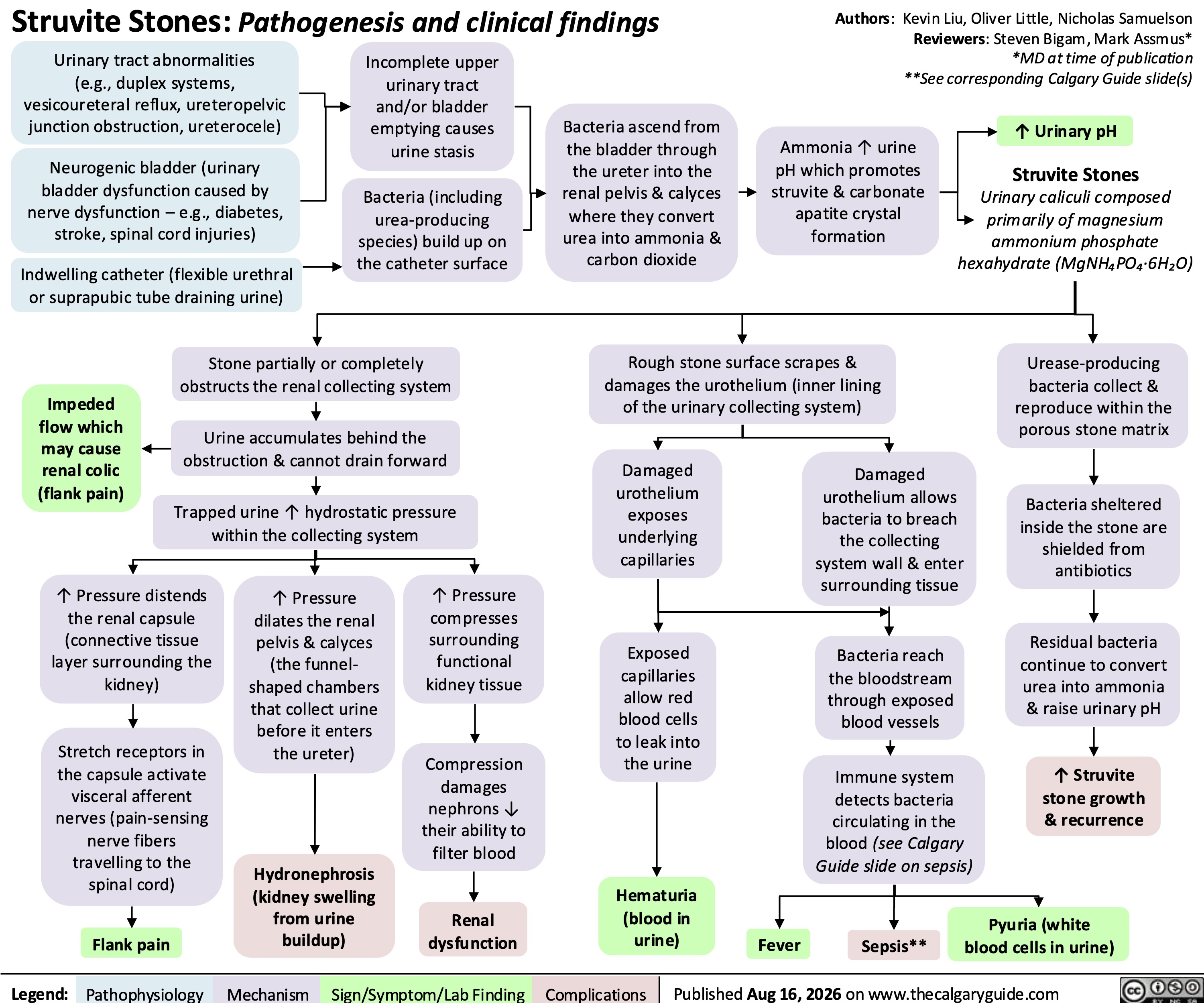
Struvite Stones: Pathogenesis and clinical findings
Urinary tract abnormalities
(e.g., duplex systems,
vesicoureteral reflux, ureteropelvic
junction obstruction, ureterocele)
Incomplete upper
urinary tract
and/or bladder
emptying causes
urine stasis
Neurogenic bladder (urinary
bladder dysfunction caused by
nerve dysfunction – e.g., diabetes,
stroke, spinal cord injuries)
Bacteria (including
urea-producing
species) build up on
the catheter surface
Indwelling catheter (flexible urethral
or suprapubic tube draining urine)
Stone partially or completely
obstructs the renal collecting system
Impeded
flow which
may cause
renal colic
(flank pain)
Urine accumulates behind the
obstruction & cannot drain forward
Trapped urine ↑ hydrostatic pressure
within the collecting system
↑ Pressure distends
the renal capsule
(connective tissue
layer surrounding the
kidney)
Stretch receptors in
the capsule activate
visceral afferent
nerves (pain-sensing
nerve fibers
Flank pain
travelling to the
spinal cord)
↑ Pressure
dilates the renal
pelvis & calyces
(the funnel-
shaped chambers
↑ Pressure
compresses
surrounding
functional
kidney tissue
that collect urine
before it enters
the ureter) Compression
damages
nephrons ↓
their ability to
filter blood
Flank pain
Hydronephrosis
(kidney swelling
from urine
buildup)
Renal
dysfunction
Authors: Kevin Liu, Oliver Little, Nicholas Samuelson
Reviewers: Steven Bigam, Mark Assmus*
*MD at time of publication
**See corresponding Calgary Guide slide(s)
Bacteria ascend from
the bladder through
the ureter into the
renal pelvis & calyces
where they convert
urea into ammonia &
carbon dioxide
↑ Urinary pH
Ammonia ↑ urine
pH which promotes
struvite & carbonate
apatite crystal
formation
Struvite Stones
Urinary caliculi composed
primarily of magnesium
ammonium phosphate
hexahydrate (MgNH₄PO₄·6H₂O)
Rough stone surface scrapes &
damages the urothelium (inner lining
of the urinary collecting system)
Urease-producing
bacteria collect &
reproduce within the
porous stone matrix
Damaged
urothelium
exposes
underlying
capillaries
Damaged
urothelium allows
bacteria to breach
the collecting
system wall & enter
surrounding tissue
Bacteria sheltered
inside the stone are
shielded from
antibiotics
Exposed
capillaries
allow red
blood cells
to leak into
the urine
Bacteria reach
the bloodstream
through exposed
blood vessels
Residual bacteria
continue to convert
urea into ammonia
& raise urinary pH
Immune system
detects bacteria
circulating in the
blood (see Calgary
Guide slide on sepsis)
↑ Struvite
stone growth
& recurrence
Hematuria
(blood in
urine)
Fever
Sepsis**
Pyuria (white
blood cells in urine)
Legend: Pathophysiology Mechanism
Sign/Symptom/Lab Finding Complications
Published Aug 16, 2026 on www.thecalgaryguide.com
Creative
Commons