SEARCH RESULTS FOR: Secondary-Hypertriglyceridemia

Secondary Hypertriglyceridemia
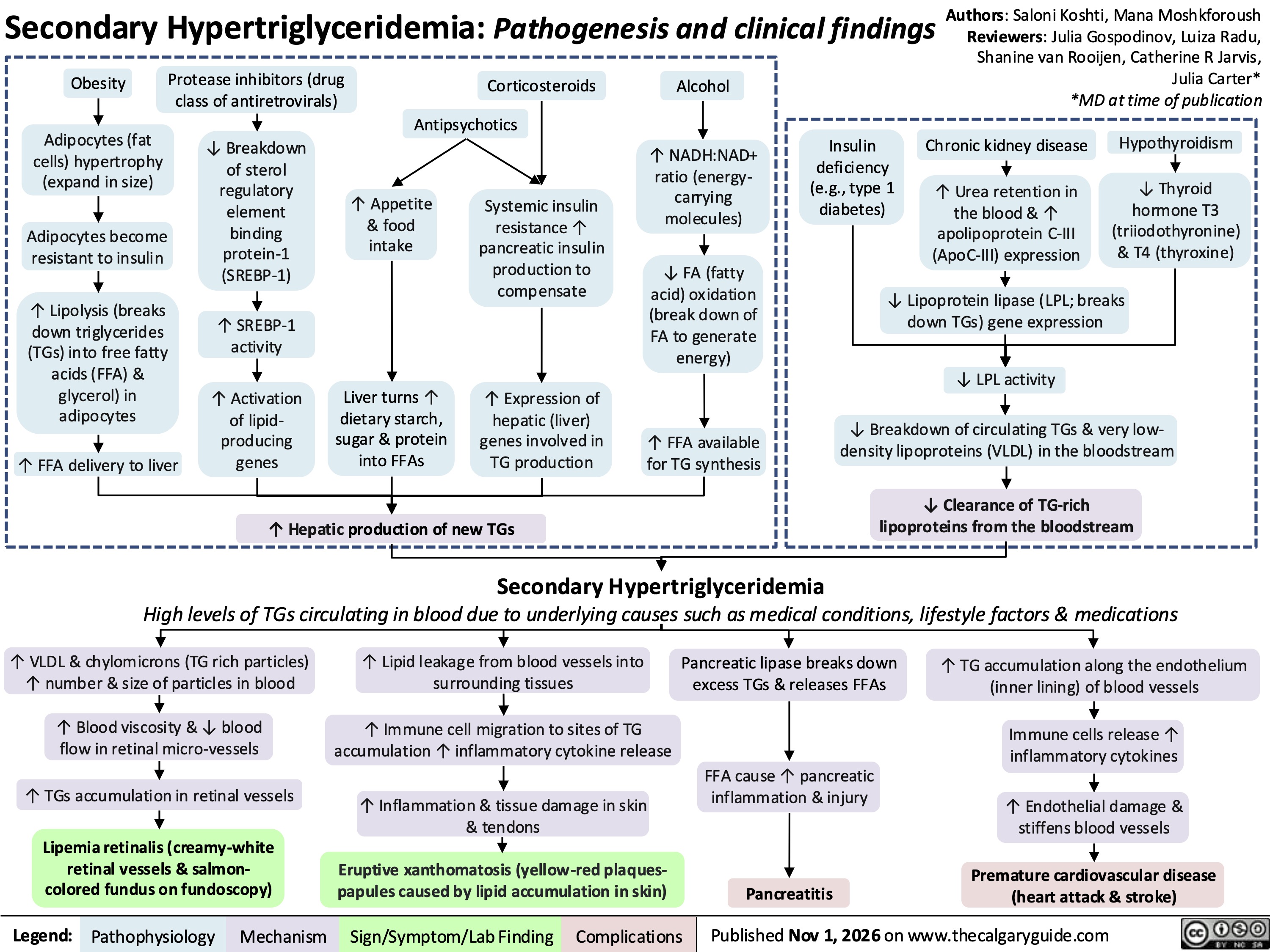
Secondary Hypertriglyceridemia: Pathogenesis and clinical findings
Authors: Saloni Koshti, Mana Moshkforoush
Reviewers: Julia Gospodinov, Luiza Radu,
Shanine van Rooijen, Catherine R Jarvis,
Julia Carter*
*MD at time of publication
Obesity
Protease inhibitors (drug
class of antiretrovirals)
Corticosteroids
Alcohol
Antipsychotics
Adipocytes (fat
cells) hypertrophy
(expand in size)
Adipocytes become
resistant to insulin
AhA
of sterol
regulatory
element
binding
protein-1
(SREBP-1)
ApA
& food
intake
Systemic insulin
ANADH:NAD+
ratio (energy-
carrying
molecules)
AA
pancreatic insulin
production to
compensate
ALipolysis (breaks
down triglycerides
(TGs) into free fatty
ASREBP-1
activity
acids (FFA) &
glycerol) in
ApA
Liver turns
adipocytes
of lipid-
dietary starch,
producing
sugar & protein
genes involved in
AwwpAAA
genes
into FFAs
TG production
FA (fatty
acid) oxidation
(break down of
FA to generate
energy)
Expression of
hepatic (liver)
AwwpAA
for TG synthesis
H production of new TGs
Insulin
deficiency
(e.g., type 1
diabetes)
Chronic kidney disease Hypothyroidism
AAAA
AAAA
apolipoprotein C-III
(ApoC-III) expression
AA
hormone T3
(triiodothyronine)
& T4 (thyroxine)
AAAAA
down TGs) gene expression
AA
AhAAAIAAA-
density lipoproteins (VLDL) in the bloodstream
HGHH-rich
lipoproteins from the bloodstream
Secondary Hypertriglyceridemia
High levels of TGs circulating in blood due to underlying causes such as medical conditions, lifestyle factors & medications
AGAAAIAAA
AAAAAAA
AhAAAAA
flow in retinal micro-vessels
ATGs accumulation in retinal vessels
Lipemia retinalis (creamy-white
retinal vessels & salmon-
colored fundus on fundoscopy)
AAArom blood vessels into
surrounding tissues
Pancreatic lipase breaks down
excess TGs & releases FFAs
AImmune cell migration to sites of TG
accumulation inflammatory cytokine release
wwpAAAA
inflammation & injury
AInflammation & tissue damage in skin
& tendons
Eruptive xanthomatosis (yellow-red plaques-
papules caused by lipid accumulation in skin)
Pancreatitis
ATG accumulation along the endothelium
(inner lining) of blood vessels
AAAA
inflammatory cytokines
AzAAA
stiffens blood vessels
Premature cardiovascular disease
(heart attack & stroke)
Legend: Pathophysiology Mechanism
Sign/Symptom/Lab Finding Complications
Published Nov 1, 2026 on www.thecalgaryguide.com
Creative
Commons