SEARCH RESULTS FOR: Reactive-infectious-mucocutaneous-eruption

Reactive infectious mucocutaneous eruption
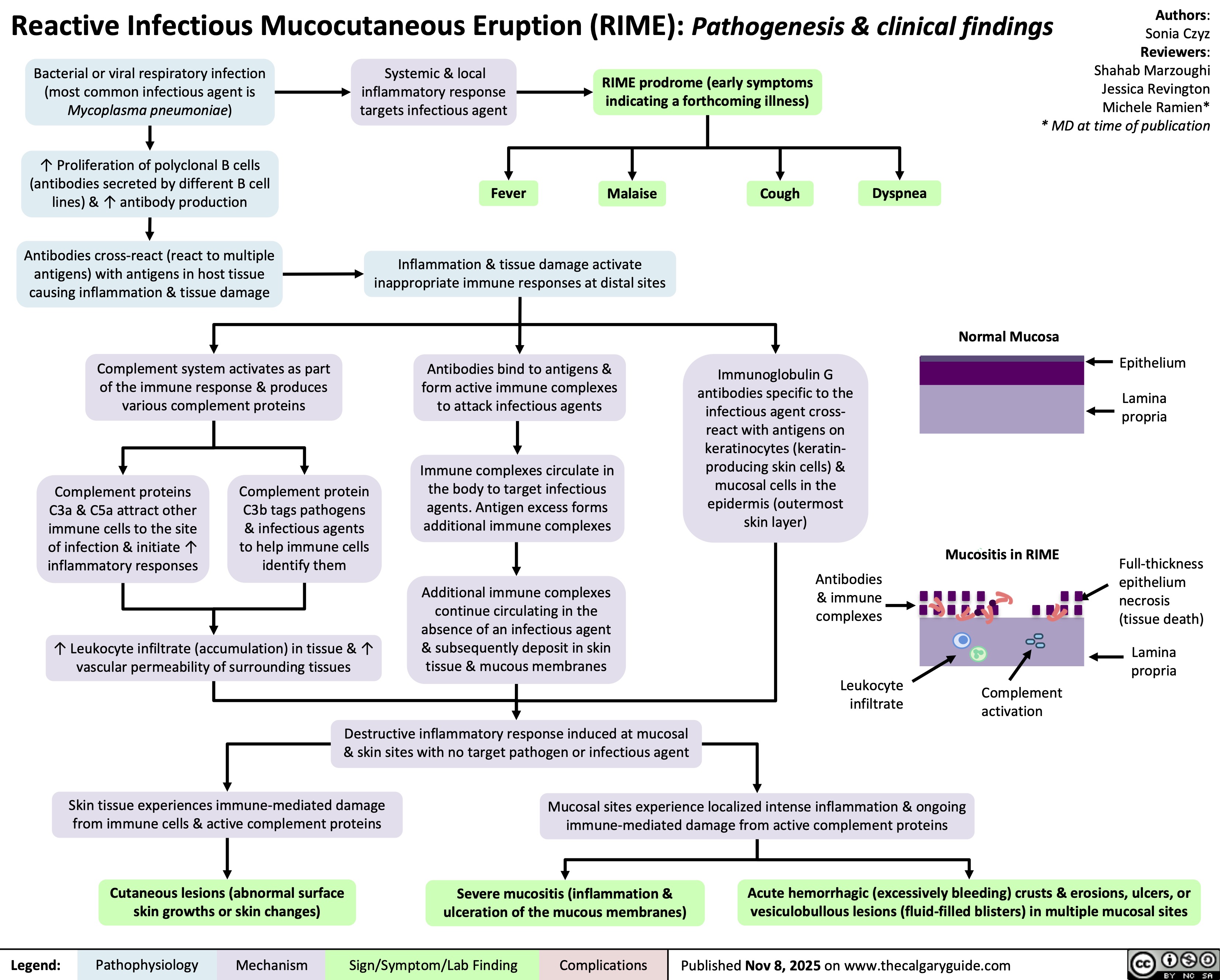
Reactive Infectious Mucocutaneous Eruption (RIME): Pathogenesis & clinical findings
Bacterial or viral respiratory infection
(most common infectious agent is
Mycoplasma pneumoniae)
↑ Proliferation of polyclonal B cells
(antibodies secreted by different B cell
lines) & ↑ antibody production
Antibodies cross-react (react to multiple
antigens) with antigens in host tissue
causing inflammation & tissue damage
Systemic & local
inflammatory response
targets infectious agent
RIME prodrome (early symptoms
indicating a forthcoming illness)
Fever
Malaise
Cough Dyspnea
Inflammation & tissue damage activate
inappropriate immune responses at distal sites
Authors:
Sonia Czyz
Reviewers:
Shahab Marzoughi
Jessica Revington
Michele Ramien*
* MD at time of publication
Normal Mucosa
Complement system activates as part
of the immune response & produces
various complement proteins
Epithelium
Lamina
propria
Complement proteins
C3a & C5a attract other
immune cells to the site
of infection & initiate ↑
inflammatory responses
Complement protein
C3b tags pathogens
& infectious agents
to help immune cells
identify them
↑ Leukocyte infiltrate (accumulation) in tissue & ↑
vascular permeability of surrounding tissues
Skin tissue experiences immune-mediated damage
from immune cells & active complement proteins
Cutaneous lesions (abnormal surface
skin growths or skin changes)
Mucositis in RIME
Legend: Pathophysiology Mechanism
Antibodies bind to antigens &
form active immune complexes
to attack infectious agents
Immune complexes circulate in
the body to target infectious
agents. Antigen excess forms
additional immune complexes
Immunoglobulin G
antibodies specific to the
infectious agent cross-
react with antigens on
keratinocytes (keratin-
producing skin cells) &
mucosal cells in the
epidermis (outermost
skin layer)
Additional immune complexes
continue circulating in the
absence of an infectious agent
& subsequently deposit in skin
tissue & mucous membranes
Antibodies
& immune
complexes
Leukocyte
infiltrate
Destructive inflammatory response induced at mucosal
& skin sites with no target pathogen or infectious agent
Complement
activation
Mucosal sites experience localized intense inflammation & ongoing
immune-mediated damage from active complement proteins
Severe mucositis (inflammation &
ulceration of the mucous membranes)
Acute hemorrhagic (excessively bleeding) crusts & erosions, ulcers, or
vesiculobullous lesions (fluid-filled blisters) in multiple mucosal sites
Published Nov 8, 2025 on www.thecalgaryguide.com
Full-thickness
epithelium
necrosis
(tissue death)
Lamina
propria
Sign/Symptom/Lab Finding Complications
Mucositis in RIME
Reactive Infectious Mucocutaneous Eruption (RIME): Pathogenesis and clinical findings
Normal Mucosa
Epithelium
Bacterial or viral respiratory infection; most
common infection is Mycoplasma
pneumoniae
Systemic and local
inflammatory response
towards invading microbe
Lamina
propria
Polyclonal B cell proliferation
and antibody production
Full-thickness
epithelium necrosis
Prodrome: cough, dyspnea, malaise, fever ~1
week prior to mucocutaneous eruption
The antibodies cross-react with host tissue
causing inflammation and tissue damage
Lamina
propria
Authors:
Sonia Czyz
Reviewers:
Shahab Marzoughi
* MD at time of publication
Inappropriate immune
responses at distal sites
Molecular
mimicry
Immune complex
activation
Complement
activation
I would remove all of this
Immunoglobulin G
antibodies specific for
invading microbe cross-
react with antigens on
keratinocytes and
mucosal cells in the
epidermis
Circulating immune
complexes form in
antigen excess
C3a, C5a, and C3b
produced
Deposition in
skin and mucous
membrane
↑ Leukocyte
infiltrate and
vascular
permeability
Severe mucositis
(inflammation and
ulceration of the
mucous
membranes
Destructive
inflammatory
response at mucosal
and skin sites
Antibodies
& immune
complexes
Leukocyte
infiltrate
Complement
activation
Acute occurrence of hemorrhagic
crusts and erosions, ulcers, or
vesiculobullous lesions in 2 or
more mucosal sites
Localized inflammation and
immune response activate
complement system which
damage mucosal tissues
Immune
response leads
to painful, red
nodules
typically on
the shins
Triggering localized, intense
inflammation and immune-
mediated damage in these
specific mucosal sites.
Legend: Widespread
systemic
immune
response
Erythema
nodosum
Urticaria
Immune response
results in hives or
itchy welts on the
skin.
Pathophysiology Mechanism
Sign/Symptom/Lab Finding Complications
Cutaneous
lesions
Published MONTH, DAY, YEAR on www.thecalgaryguide.com