SEARCH RESULTS FOR: Primary-Hypercholesterolemia

Primary Hypercholesterolemia
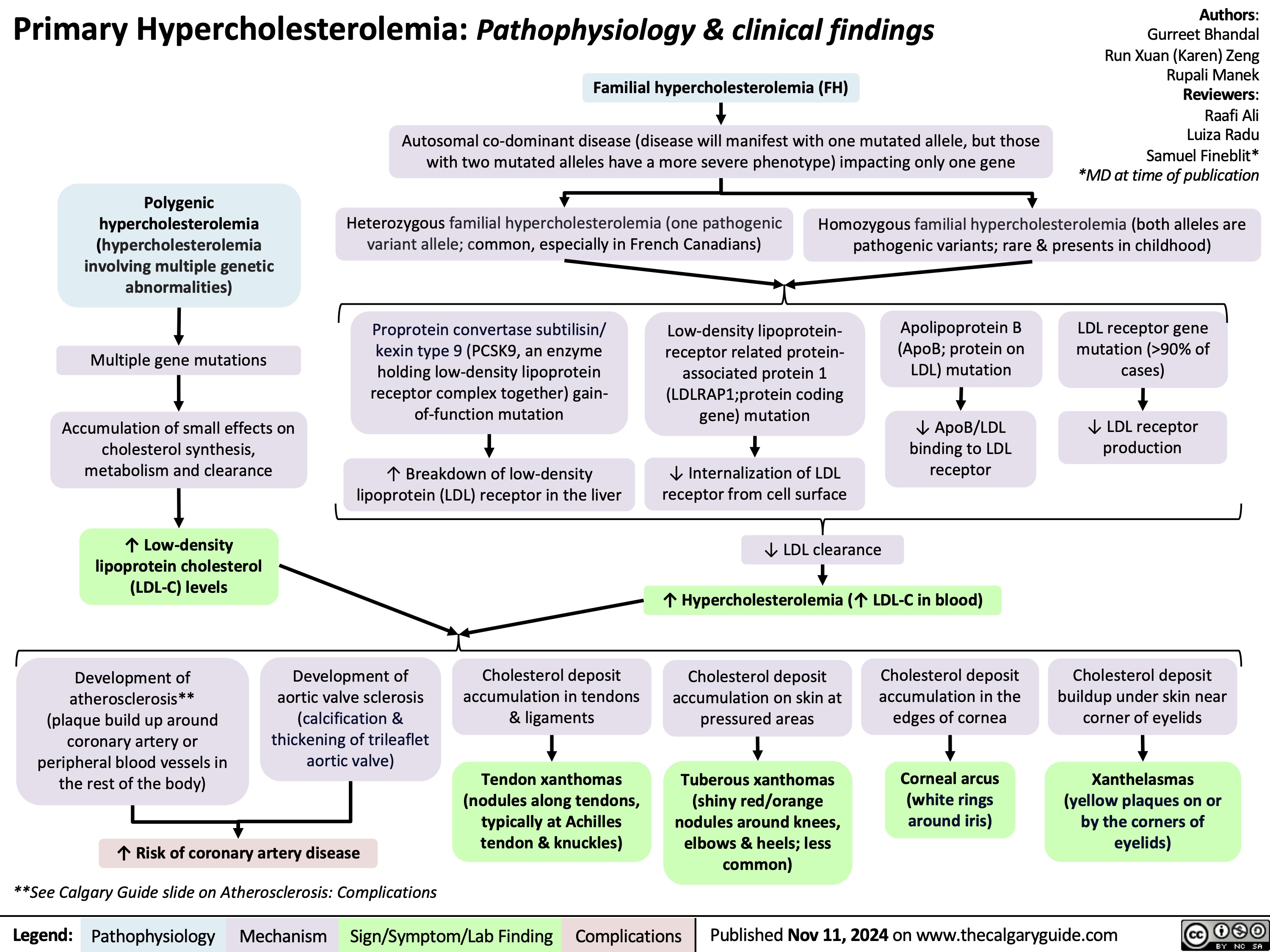
Primary Hypercholesterolemia: Pathophysiology & clinical findings Familial hypercholesterolemia (FH)
Authors: Gurreet Bhandal Run Xuan (Karen) Zeng Rupali Manek Reviewers: Raafi Ali Luiza Radu Samuel Fineblit* *MD at time of publication
  Autosomal co-dominant disease (disease will manifest with one mutated allele, but those with two mutated alleles have a more severe phenotype) impacting only one gene
  Polygenic hypercholesterolemia (hypercholesterolemia involving multiple genetic abnormalities)
Multiple gene mutations
Accumulation of small effects on cholesterol synthesis, metabolism and clearance
↑ Low-density lipoprotein cholesterol (LDL-C) levels
Development of atherosclerosis** (plaque build up around coronary artery or peripheral blood vessels in the rest of the body)
Heterozygous familial hypercholesterolemia (one pathogenic variant allele; common, especially in French Canadians)
Homozygous familial hypercholesterolemia (both alleles are pathogenic variants; rare & presents in childhood)
         Proprotein convertase subtilisin/ kexin type 9 (PCSK9, an enzyme holding low-density lipoprotein receptor complex together) gain- of-function mutation
↑ Breakdown of low-density lipoprotein (LDL) receptor in the liver
Low-density lipoprotein- receptor related protein- associated protein 1 (LDLRAP1;protein coding gene) mutation
↓ Internalization of LDL receptor from cell surface
↓ LDL clearance
Apolipoprotein B (ApoB; protein on LDL) mutation
↓ ApoB/LDL binding to LDL receptor
LDL receptor gene mutation (>90% of cases)
↓ LDL receptor production
           ↑ Hypercholesterolemia (↑ LDL-C in blood)
        Development of aortic valve sclerosis (calcification & thickening of trileaflet aortic valve)
Cholesterol deposit accumulation in tendons & ligaments
Tendon xanthomas (nodules along tendons, typically at Achilles tendon & knuckles)
Cholesterol deposit accumulation on skin at pressured areas
Tuberous xanthomas (shiny red/orange nodules around knees, elbows & heels; less common)
Cholesterol deposit accumulation in the edges of cornea
Corneal arcus (white rings around iris)
Cholesterol deposit buildup under skin near corner of eyelids
Xanthelasmas (yellow plaques on or by the corners of eyelids)
      ↑ Risk of coronary artery disease
**See Calgary Guide slide on Atherosclerosis: Complications
 Legend:
 Pathophysiology
Mechanism
Sign/Symptom/Lab Finding
 Complications
 Published Nov 11, 2024 on www.thecalgaryguide.com