SEARCH RESULTS FOR: Perioperative-Aspiration-Syndrome

Perioperative Aspiration Syndrome
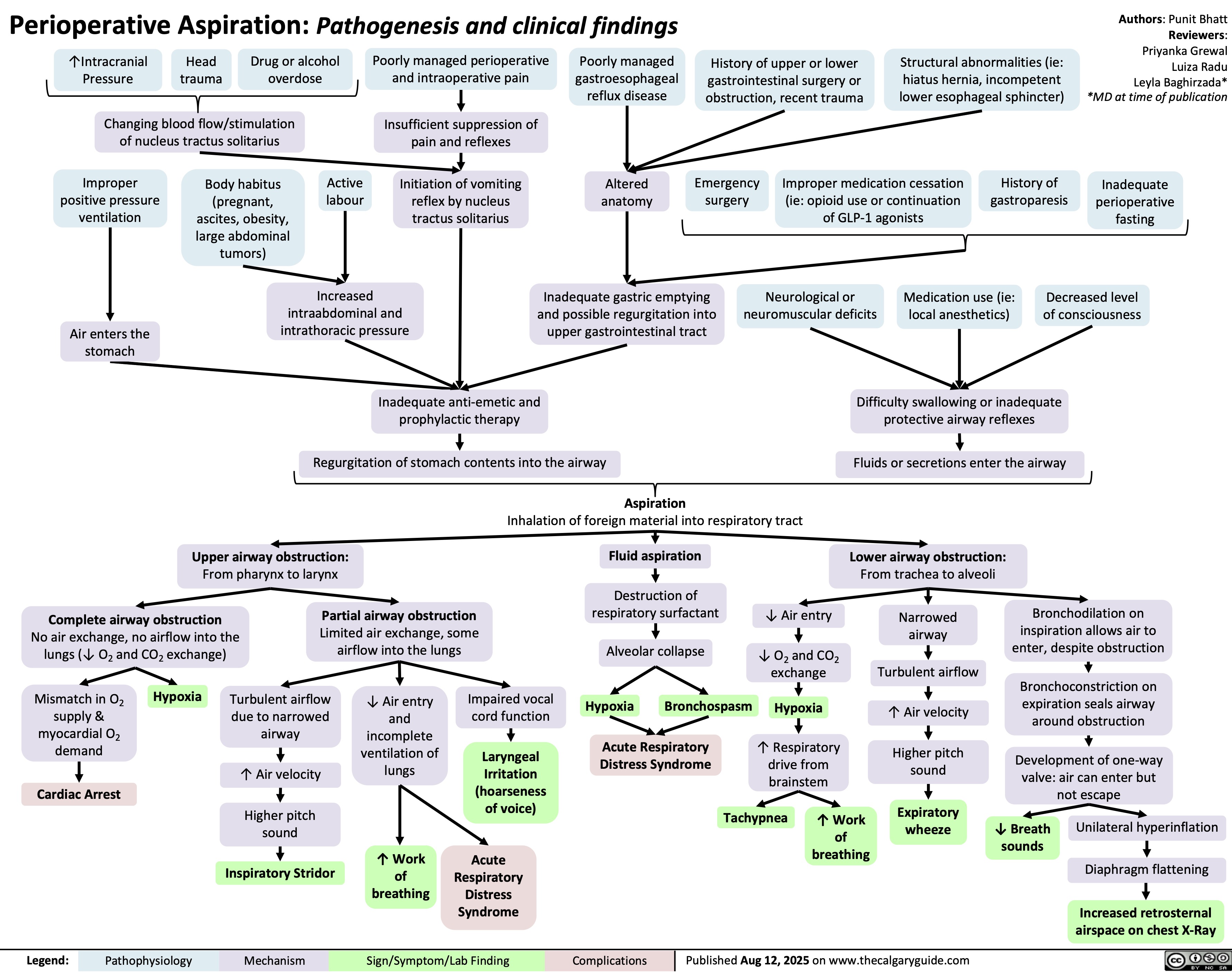
Perioperative Aspiration: Pathogenesis and clinical findings
↑Intracranial
Pressure
Head
trauma
Drug or alcohol
overdose
Poorly managed perioperative
and intraoperative pain
Poorly managed
gastroesophageal
reflux disease
History of upper or lower
gastrointestinal surgery or
obstruction, recent trauma
Structural abnormalities (ie:
hiatus hernia, incompetent
lower esophageal sphincter)
Authors: Punit Bhatt
Reviewers:
Priyanka Grewal
Luiza Radu
Leyla Baghirzada*
*MD at time of publication
Changing blood flow/stimulation
of nucleus tractus solitarius
Insufficient suppression of
pain and reflexes
Improper
positive pressure
ventilation
Body habitus
(pregnant,
ascites, obesity,
large abdominal
tumors)
Active
labour
Initiation of vomiting
reflex by nucleus
tractus solitarius
Altered
anatomy
Emergency
surgery
Improper medication cessation
(ie: opioid use or continuation
of GLP-1 agonists
History of
gastroparesis
Inadequate
perioperative
fasting
Increased
intraabdominal and
intrathoracic pressure
Inadequate gastric emptying
and possible regurgitation into
upper gastrointestinal tract
Neurological or
neuromuscular deficits
Medication use (ie:
local anesthetics)
Decreased level
of consciousness
Air enters the
stomach
Inadequate anti-emetic and
prophylactic therapy
Difficulty swallowing or inadequate
protective airway reflexes
Regurgitation of stomach contents into the airway
Fluids or secretions enter the airway
Aspiration
Inhalation of foreign material into respiratory tract
Upper airway obstruction:
From pharynx to larynx
Fluid aspiration
Lower airway obstruction:
From trachea to alveoli
Destruction of
respiratory surfactant
Complete airway obstruction
No air exchange, no airflow into the
lungs (↓ O2 and CO2 exchange)
Partial airway obstruction
Limited air exchange, some
airflow into the lungs
↓ Air entry
Narrowed
airway
Alveolar collapse
Bronchodilation on
inspiration allows air to
enter, despite obstruction
↓ O2 and CO2
exchange
Turbulent airflow
Mismatch in O2
Hypoxia
Turbulent airflow
supply &
due to narrowed
myocardial O2
airway
demand
Cardiac Arrest
Laryngeal
Irritation
(hoarseness
of voice)
Acute Respiratory
Distress Syndrome
↑ Respiratory
drive from
brainstem
Higher pitch
sound
↑ Air velocity
↓ Air entry
and
incomplete
ventilation of
lungs
Impaired vocal
cord function
Hypoxia Bronchospasm
Hypoxia ↑ Air velocity
Bronchoconstriction on
expiration seals airway
around obstruction
Development of one-way
valve: air can enter but
not escape
Higher pitch
sound
Tachypnea ↑ Work
of
breathing
Expiratory
wheeze
↓ Breath
sounds
Unilateral hyperinflation
Inspiratory Stridor
↑ Work
of
breathing
Acute
Respiratory
Distress
Syndrome
Diaphragm flattening
Increased retrosternal
airspace on chest X-Ray
Legend: Pathophysiology Mechanism
Sign/Symptom/Lab Finding Complications
Published Aug 12, 2025 on www.thecalgaryguide.com