SEARCH RESULTS FOR: Opioid-Use-Disorder

Opioid Use Disorder
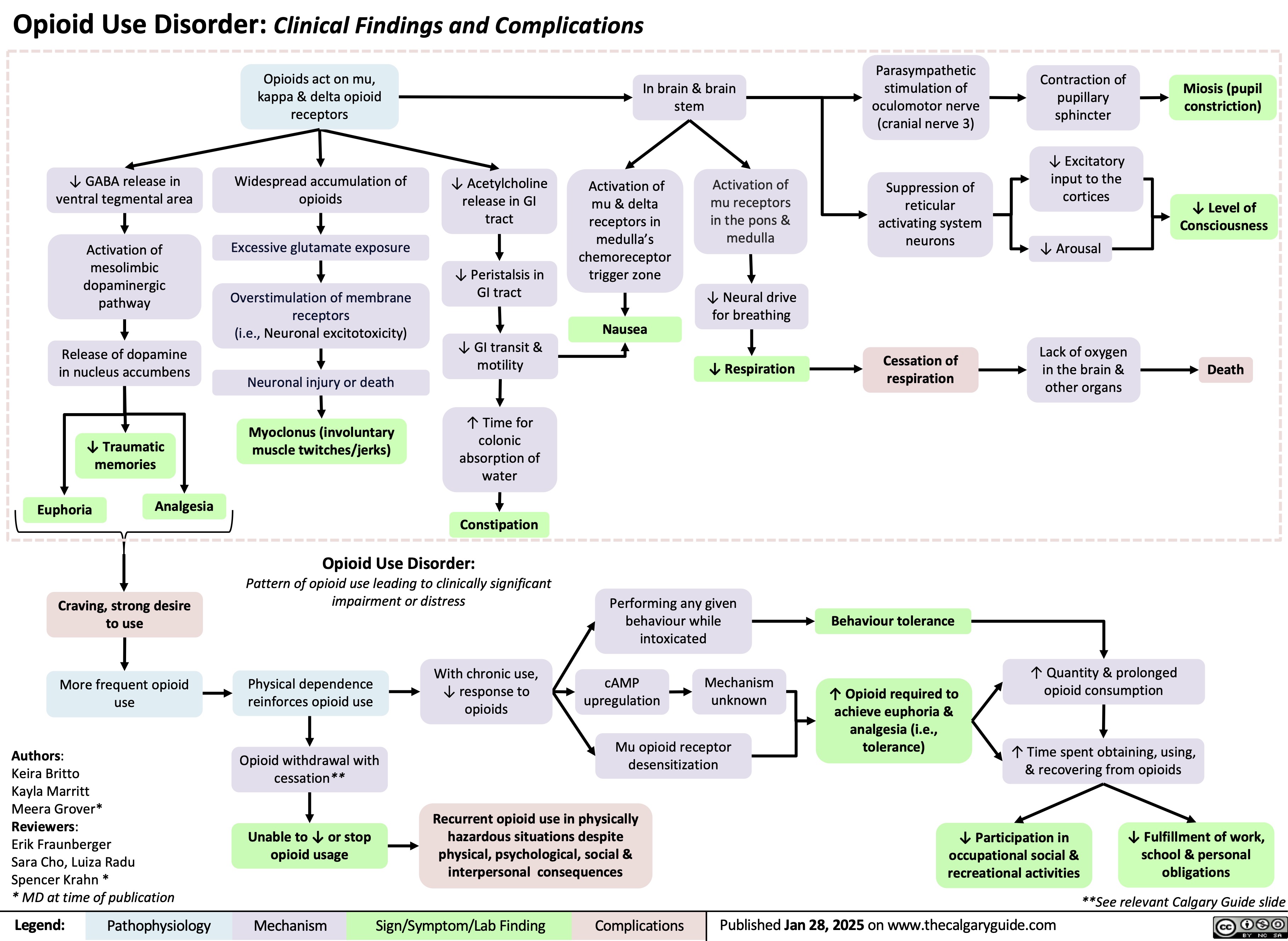
Opioid Use Disorder: Clinical Findings and Complications
    Opioids act on mu, kappa & delta opioid receptors
Widespread accumulation of opioids
Excessive glutamate exposure
Overstimulation of membrane receptors
(i.e., Neuronal excitotoxicity)
Neuronal injury or death
Myoclonus (involuntary muscle twitches/jerks)
In brain & brain stem
Parasympathetic stimulation of oculomotor nerve (cranial nerve 3)
Suppression of reticular activating system neurons
Cessation of respiration
Contraction of pupillary sphincter
↓ Excitatory input to the cortices
↓ Arousal
Lack of oxygen in the brain & other organs
Miosis (pupil constriction)
↓ Level of Consciousness
Death
             ↓ GABA release in ventral tegmental area
Activation of mesolimbic dopaminergic pathway
Release of dopamine in nucleus accumbens
↓ Traumatic memories
↓ Acetylcholine release in GI tract
↓ Peristalsis in GI tract
↓ GI transit & motility
↑ Time for colonic absorption of water
Constipation
Activation of mu & delta receptors in medulla’s chemoreceptor trigger zone
Nausea
Activation of mu receptors in the pons & medulla
↓ Neural drive for breathing
↓ Respiration
                      Euphoria
Analgesia
   Craving, strong desire to use
More frequent opioid use
Authors:
Keira Britto
Kayla Marritt
Meera Grover*
Reviewers:
Erik Fraunberger
Sara Cho, Luiza Radu Spencer Krahn *
* MD at time of publication
Opioid Use Disorder:
Pattern of opioid use leading to clinically significant impairment or distress
Performing any given behaviour while intoxicated
cAMP Mechanism upregulation unknown
Mu opioid receptor desensitization
        Physical dependence reinforces opioid use
Opioid withdrawal with cessation**
Unable to ↓ or stop opioid usage
With chronic use, ↓ response to opioids
Behaviour tolerance
↑ Opioid required to achieve euphoria & analgesia (i.e., tolerance)
↑ Quantity & prolonged opioid consumption
↑ Time spent obtaining, using, & recovering from opioids
       Recurrent opioid use in physically hazardous situations despite physical, psychological, social & interpersonal consequences
↓ Participation in occupational social & recreational activities
↓ Fulfillment of work, school & personal obligations
**See relevant Calgary Guide slide
    Legend:
 Pathophysiology
 Mechanism
 Sign/Symptom/Lab Finding
 Complications
Published Jan 28, 2025 on www.thecalgaryguide.com