SEARCH RESULTS FOR: Hypoxic-Ischemic-Encephalopathy

Hypoxic Ischemic Encephalopathy
Authors:
Isabella Reis, Alam Randhawa
Reviewers:
Annie Pham, Taylor Krawec,
Emily J. Doucette, Danielle Nelson*
*MD at the time of publication
**See corresponding Calgary Guide slide
Legend: Pathophysiology Mechanism
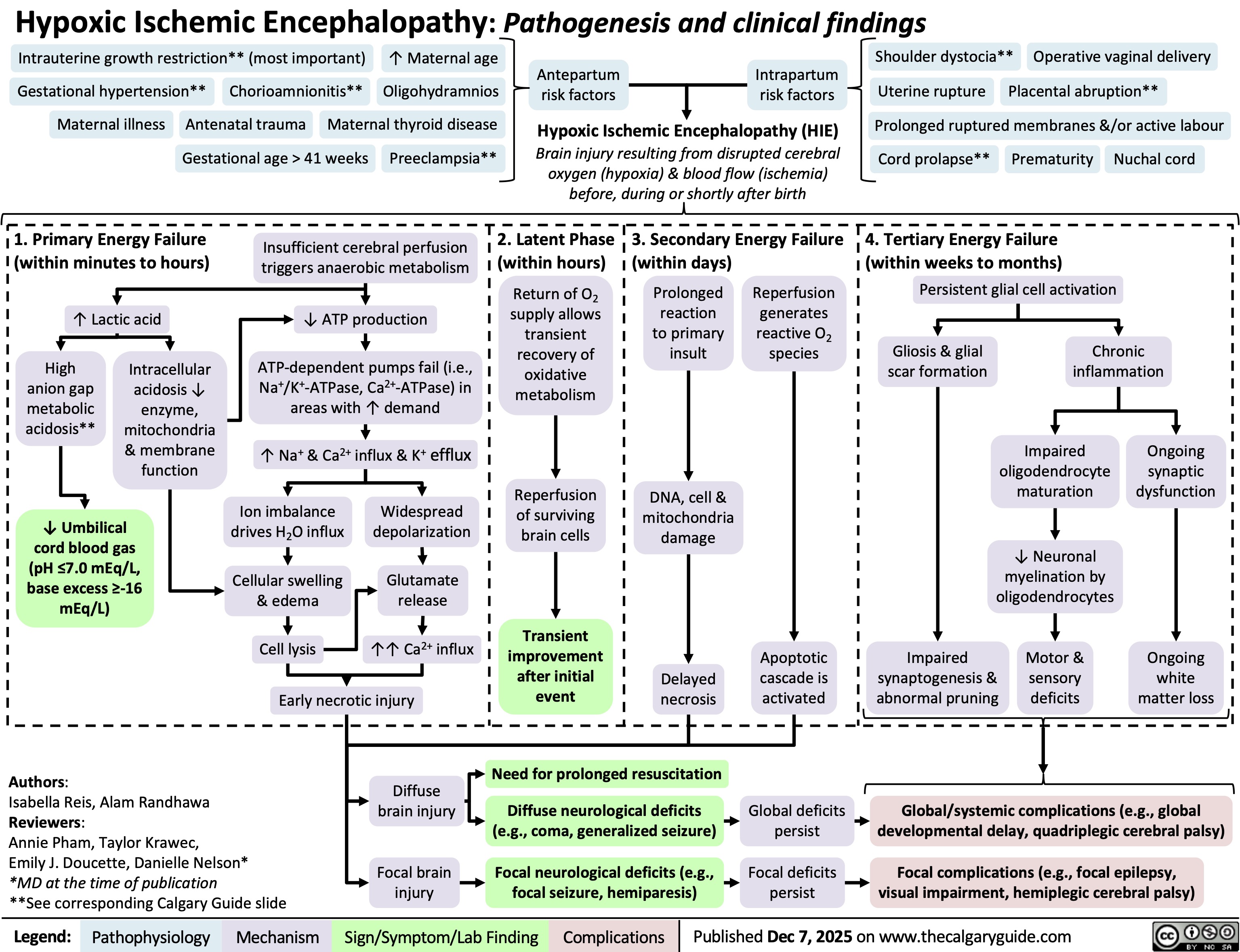
Hypoxic Ischemic Encephalopathy: Pathogenesis and clinical findings
Intrauterine growth restriction** (most important)
↑ Maternal age
Gestational hypertension**
Chorioamnionitis** Oligohydramnios
Antepartum
risk factors
Intrapartum
risk factors
Antenatal trauma
Maternal illness Maternal thyroid disease
Gestational age > 41 weeks
Preeclampsia**
Hypoxic Ischemic Encephalopathy (HIE)
Brain injury resulting from disrupted cerebral
oxygen (hypoxia) & blood flow (ischemia)
before, during or shortly after birth
1. Primary Energy Failure
(within minutes to hours)
Insufficient cerebral perfusion
triggers anaerobic metabolism
2. Latent Phase
(within hours)
3. Secondary Energy Failure
(within days)
↑ Lactic acid
↓ ATP production
High
anion gap
metabolic
acidosis**
ATP-dependent pumps fail (i.e.,
Na+/K+
-ATPase, Ca2+
-ATPase) in
areas with ↑ demand
Return of O2
supply allows
transient
recovery of
oxidative
metabolism
Prolonged
reaction
to primary
insult
Intracellular
acidosis ↓
enzyme,
mitochondria
& membrane
function
↑ Na+ & Ca2+ influx & K+ efflux
Reperfusion
Ion imbalance
Widespread
of surviving
↓ Umbilical
drives H2O influx
depolarization
brain cells
cord blood gas
(pH ≤7.0 mEq/L,
base excess ≥-16
Cellular swelling
& edema
Glutamate
release
mEq/L)
Cell lysis ↑↑ Ca2+ influx
Early necrotic injury
Transient
improvement
after initial
event
Delayed
necrosis
Need for prolonged resuscitation
Diffuse
brain injury Diffuse neurological deficits
(e.g., coma, generalized seizure)
Focal brain
injury
Focal neurological deficits (e.g.,
focal seizure, hemiparesis)
Complications
Reperfusion
generates
reactive O2
species
Apoptotic
cascade is
activated
Shoulder dystocia**
Operative vaginal delivery
Uterine rupture
Placental abruption**
Prolonged ruptured membranes &/or active labour
Cord prolapse**
Prematurity
Nuchal cord
DNA, cell &
mitochondria
damage
4. Tertiary Energy Failure
(within weeks to months)
Persistent glial cell activation
Gliosis & glial
scar formation
Chronic
inflammation
Impaired
oligodendrocyte
maturation
↓ Neuronal
myelination by
oligodendrocytes
Impaired
synaptogenesis &
abnormal pruning
Motor &
sensory
deficits
Ongoing
synaptic
dysfunction
Ongoing
white
matter loss
Sign/Symptom/Lab Finding Global deficits
persist
Focal deficits
persist
Global/systemic complications (e.g., global
developmental delay, quadriplegic cerebral palsy)
Focal complications (e.g., focal epilepsy,
visual impairment, hemiplegic cerebral palsy)
Published Dec 7, 2025 on www.thecalgaryguide.com