SEARCH RESULTS FOR: Hereditary-Spherocytosis

Hereditary Spherocytosis
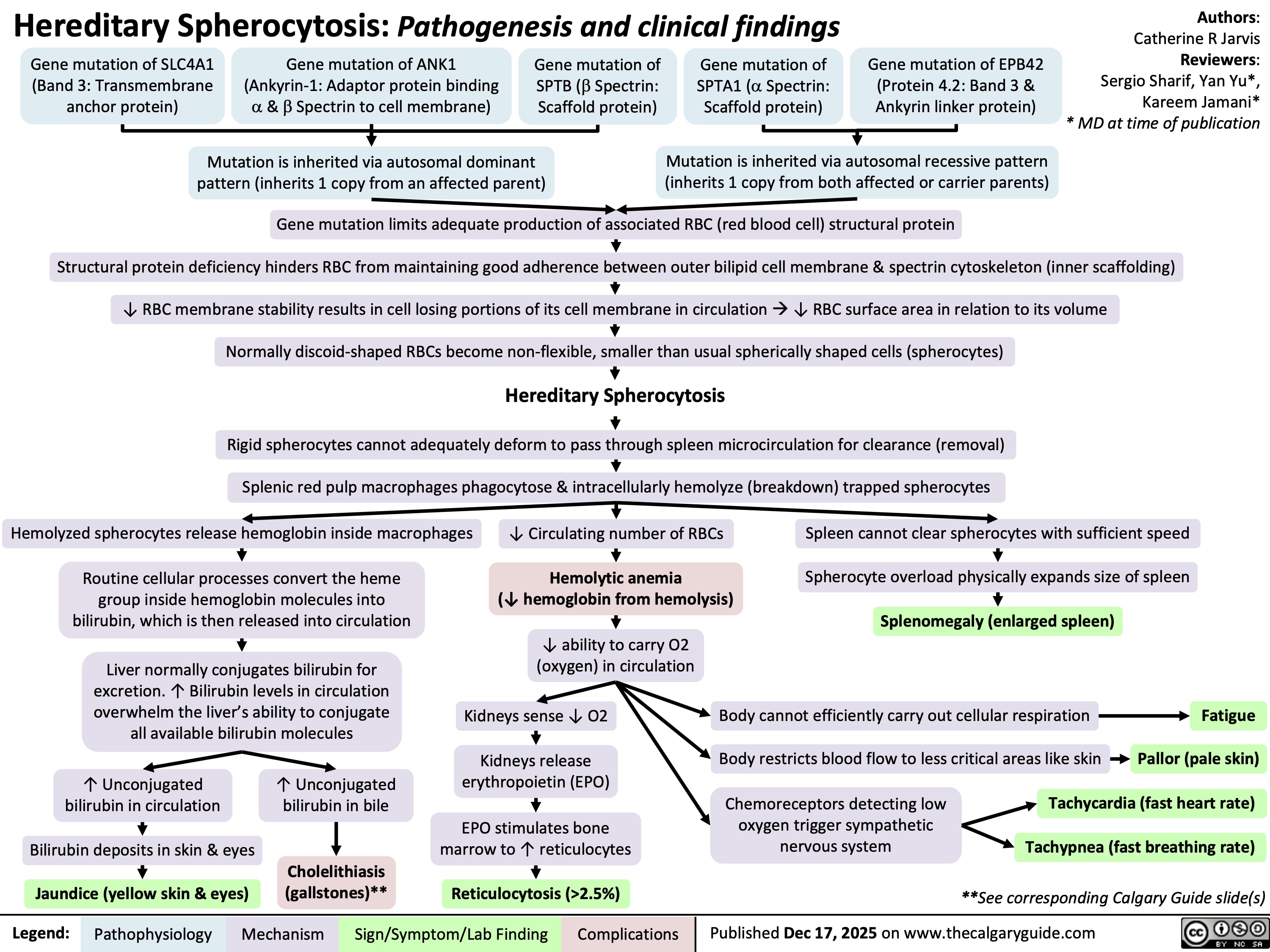
Hereditary Spherocytosis: Pathogenesis and clinical findings
Gene mutation of SLC4A1
(Band 3: Transmembrane
anchor protein)
Gene mutation of ANK1
(Ankyrin-1: Adaptor protein binding
a & b Spectrin to cell membrane)
Gene mutation of
SPTB (b Spectrin:
Scaffold protein)
Gene mutation of
SPTA1 (a Spectrin:
Scaffold protein)
Gene mutation of EPB42
(Protein 4.2: Band 3 &
Ankyrin linker protein)
Authors:
Catherine R Jarvis
Reviewers:
Sergio Sharif, Yan Yu*,
Kareem Jamani*
* MD at time of publication
Mutation is inherited via autosomal dominant
pattern (inherits 1 copy from an affected parent)
Mutation is inherited via autosomal recessive pattern
(inherits 1 copy from both affected or carrier parents)
Gene mutation limits adequate production of associated RBC (red blood cell) structural protein
Structural protein deficiency hinders RBC from maintaining good adherence between outer bilipid cell membrane & spectrin cytoskeleton (inner scaffolding)
↓ RBC membrane stability results in cell losing portions of its cell membrane in circulation à ↓ RBC surface area in relation to its volume
Normally discoid-shaped RBCs become non-flexible, smaller than usual spherically shaped cells (spherocytes)
Hereditary Spherocytosis
Rigid spherocytes cannot adequately deform to pass through spleen microcirculation for clearance (removal)
Splenic red pulp macrophages phagocytose & intracellularly hemolyze (breakdown) trapped spherocytes
Hemolyzed spherocytes release hemoglobin inside macrophages
↓ Circulating number of RBCs
Spleen cannot clear spherocytes with sufficient speed
Routine cellular processes convert the heme
group inside hemoglobin molecules into
bilirubin, which is then released into circulation
Hemolytic anemia
(↓ hemoglobin from hemolysis)
Spherocyte overload physically expands size of spleen
Splenomegaly (enlarged spleen)
↓ ability to carry O2
(oxygen) in circulation
Liver normally conjugates bilirubin for
excretion. ↑ Bilirubin levels in circulation
overwhelm the liver’s ability to conjugate
all available bilirubin molecules
Kidneys sense ↓ O2
Kidneys release
erythropoietin (EPO)
↑ Unconjugated
bilirubin in circulation ↑ Unconjugated
bilirubin in bile
Bilirubin deposits in skin & eyes
EPO stimulates bone
marrow to ↑ reticulocytes
Jaundice (yellow skin & eyes)
Cholelithiasis
(gallstones)**
Reticulocytosis (>2.5%)
Legend: Pathophysiology Mechanism
Sign/Symptom/Lab Finding Complications
Body cannot efficiently carry out cellular respiration
Fatigue
Body restricts blood flow to less critical areas like skin
Pallor (pale skin)
Chemoreceptors detecting low
oxygen trigger sympathetic
nervous system
Tachycardia (fast heart rate)
Tachypnea (fast breathing rate)
**See corresponding Calgary Guide slide(s)
Published Dec 17, 2025 on www.thecalgaryguide.com