SEARCH RESULTS FOR: Genital-Prolapse

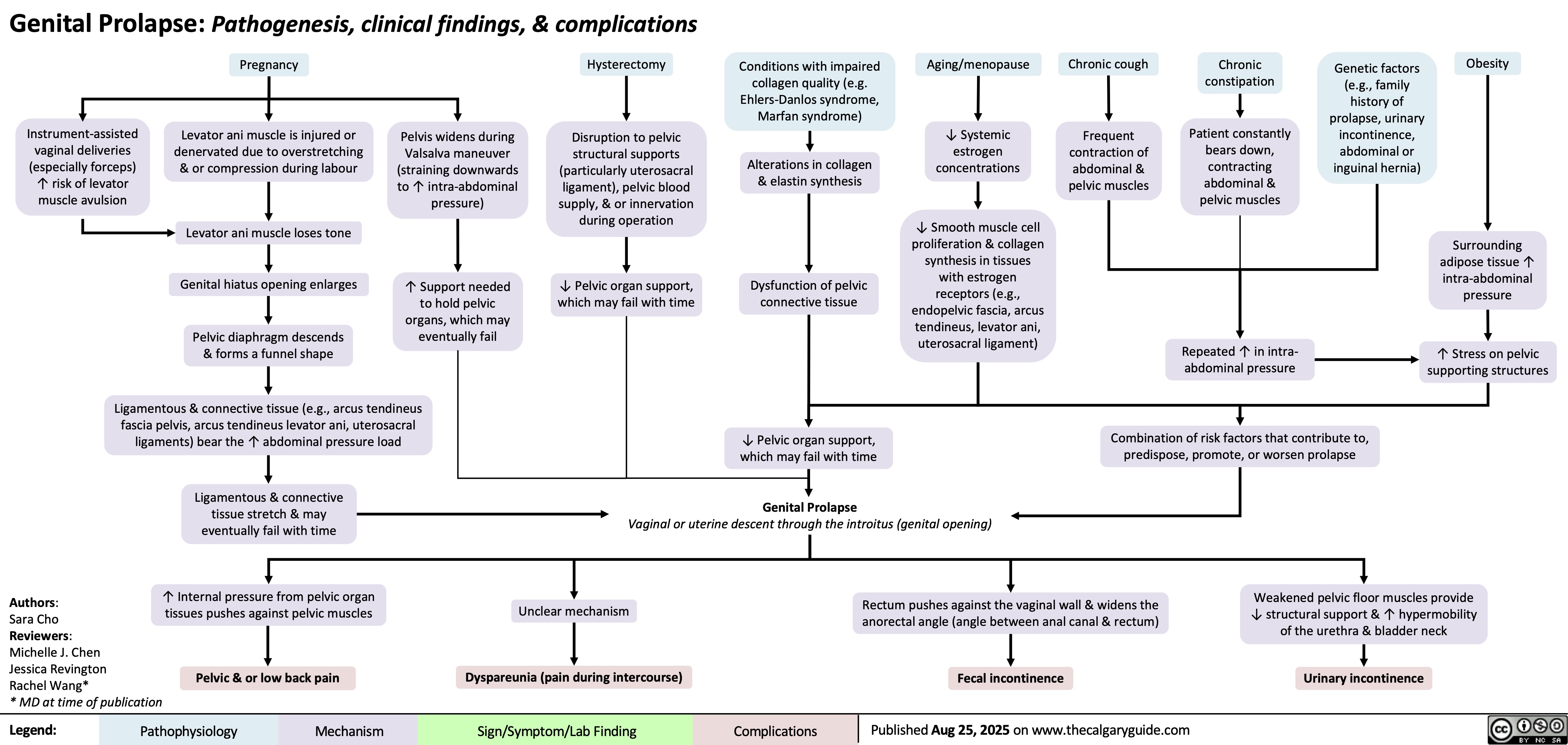
Genital Prolapse
Instrument-assisted
vaginal deliveries
(especially forceps)
↑ risk of levator
muscle avulsion
Pelvis widens during
Valsalva maneuver
(straining downwards
to ↑ intra-abdominal
pressure)
↑ Support needed
to hold pelvic
organs, which may
eventually fail
Genital Prolapse: Pathogenesis, clinical findings, & complications
Pregnancy
Levator ani muscle is injured or
denervated due to overstretching
& or compression during labour
Levator ani muscle loses tone
Genital hiatus opening enlarges
Pelvic diaphragm descends
& forms a funnel shape
Ligamentous & connective tissue (e.g., arcus tendineus
fascia pelvis, arcus tendineus levator ani, uterosacral
ligaments) bear the ↑ abdominal pressure load
Ligamentous & connective
tissue stretch & may
eventually fail with time
↑ Internal pressure from pelvic organ
tissues pushes against pelvic muscles Hysterectomy
Disruption to pelvic
structural supports
(particularly uterosacral
ligament), pelvic blood
supply, & or innervation
during operation
↓ Pelvic organ support,
which may fail with time
Authors:
Sara Cho
Reviewers:
Michelle J. Chen
Jessica Revington
Rachel Wang*
* MD at time of publication
Unclear mechanism
Pelvic & or low back pain Dyspareunia (pain during intercourse)
Legend: Pathophysiology Mechanism
Conditions with impaired
collagen quality (e.g.
Ehlers-Danlos syndrome,
Marfan syndrome)
Alterations in collagen
& elastin synthesis
Dysfunction of pelvic
connective tissue
Aging/menopause
↓ Systemic
estrogen
concentrations
↓ Smooth muscle cell
proliferation & collagen
synthesis in tissues
with estrogen
receptors (e.g.,
endopelvic fascia, arcus
tendineus, levator ani,
uterosacral ligament)
Chronic cough
Frequent
contraction of
abdominal &
pelvic muscles
Chronic
constipation
Patient constantly
bears down,
contracting
abdominal &
pelvic muscles
Genetic factors
(e.g., family
history of
prolapse, urinary
incontinence,
abdominal or
inguinal hernia)
Obesity
Surrounding
adipose tissue ↑
intra-abdominal
pressure
↑ Stress on pelvic
supporting structures
Repeated ↑ in intra-
abdominal pressure
Combination of risk factors that contribute to,
predispose, promote, or worsen prolapse
Sign/Symptom/Lab Finding ↓ Pelvic organ support,
which may fail with time
Genital Prolapse
Vaginal or uterine descent through the introitus (genital opening)
Rectum pushes against the vaginal wall & widens the
anorectal angle (angle between anal canal & rectum)
Fecal incontinence
Published Aug 25, 2025 on www.thecalgaryguide.com
Weakened pelvic floor muscles provide
↓ structural support & ↑ hypermobility
of the urethra & bladder neck
Urinary incontinence
Complications