• Content
  • Collaboration
  • About Us
  • Contact Us

SEARCH RESULTS FOR: Diphtheria

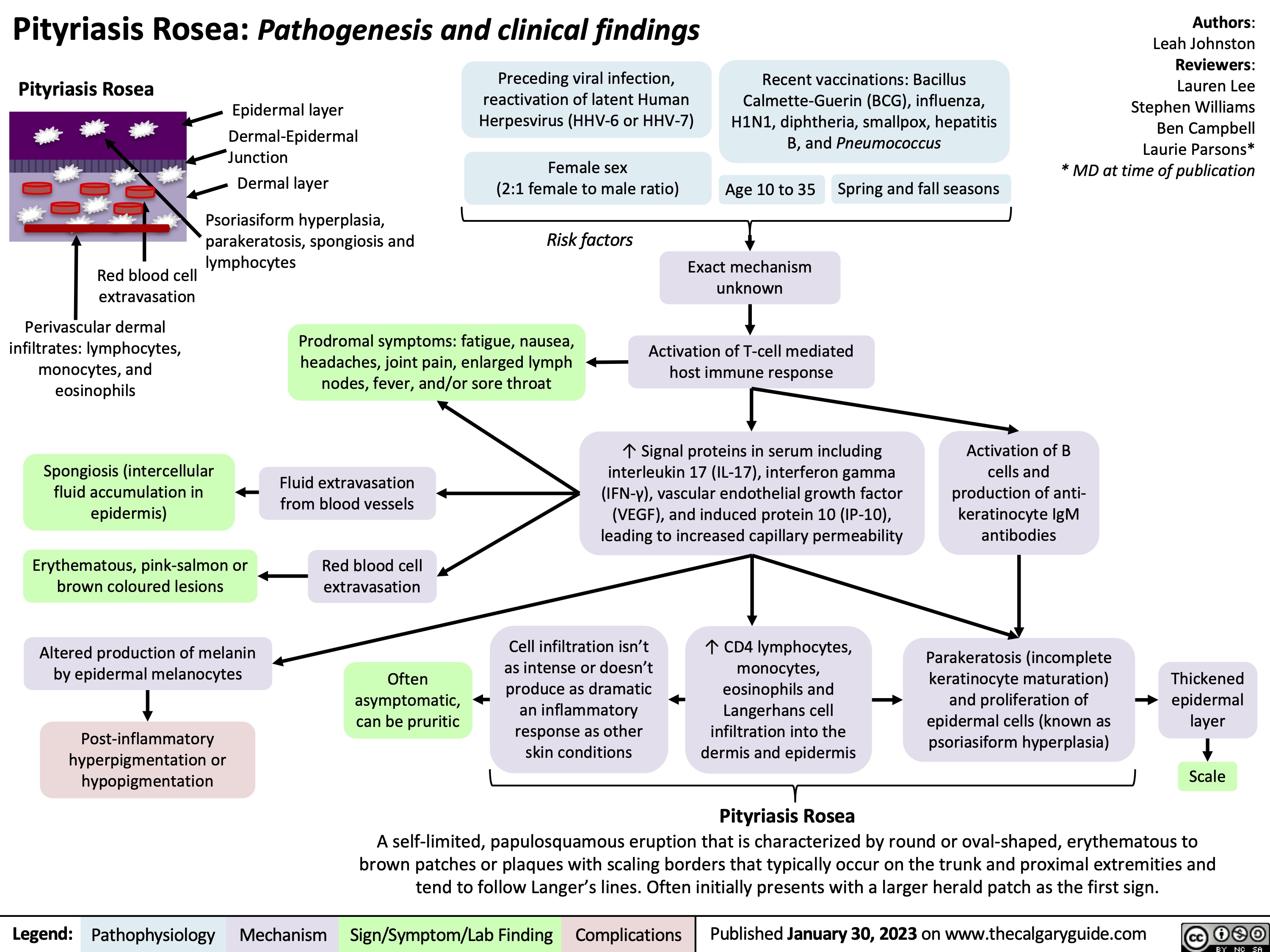
Pityriasis Rosea

Pityriasis Rosea: Pathogenesis and clinical findings
Authors: Leah Johnston Reviewers: Lauren Lee Stephen Williams Ben Campbell Laurie Parsons* * MD at time of publication
  Pityriasis Rosea
Epidermal layer
Dermal-Epidermal Junction
Dermal layer
Psoriasiform hyperplasia, parakeratosis, spongiosis and
Preceding viral infection, reactivation of latent Human Herpesvirus (HHV-6 or HHV-7)
Female sex
(2:1 female to male ratio)
Risk factors
Recent vaccinations: Bacillus Calmette-Guerin (BCG), influenza, H1N1, diphtheria, smallpox, hepatitis B, and Pneumococcus
                           Red blood cell lymphocytes extravasation
Perivascular dermal infiltrates: lymphocytes, monocytes, and eosinophils
Spongiosis (intercellular fluid accumulation in epidermis)
Erythematous, pink-salmon or brown coloured lesions
Altered production of melanin by epidermal melanocytes
Post-inflammatory hyperpigmentation or hypopigmentation
Prodromal symptoms: fatigue, nausea, headaches, joint pain, enlarged lymph nodes, fever, and/or sore throat
Age 10 to 35
Exact mechanism unknown
Activation of T-cell mediated host immune response
↑ Signal proteins in serum including interleukin 17 (IL-17), interferon gamma (IFN-γ), vascular endothelial growth factor (VEGF), and induced protein 10 (IP-10), leading to increased capillary permeability
Spring and fall seasons
         Fluid extravasation from blood vessels
Red blood cell extravasation
Often asymptomatic, can be pruritic
Cell infiltration isn’t as intense or doesn’t produce as dramatic an inflammatory response as other skin conditions
↑ CD4 lymphocytes, monocytes, eosinophils and Langerhans cell infiltration into the dermis and epidermis
Pityriasis Rosea
Activation of B cells and production of anti- keratinocyte IgM antibodies
Parakeratosis (incomplete keratinocyte maturation) and proliferation of epidermal cells (known as psoriasiform hyperplasia)
Thickened epidermal layer
Scale
                A self-limited, papulosquamous eruption that is characterized by round or oval-shaped, erythematous to brown patches or plaques with scaling borders that typically occur on the trunk and proximal extremities and tend to follow Langer’s lines. Often initially presents with a larger herald patch as the first sign.
 Legend:
 Pathophysiology
 Mechanism
Sign/Symptom/Lab Finding
 Complications
Published January 30, 2023 on www.thecalgaryguide.com

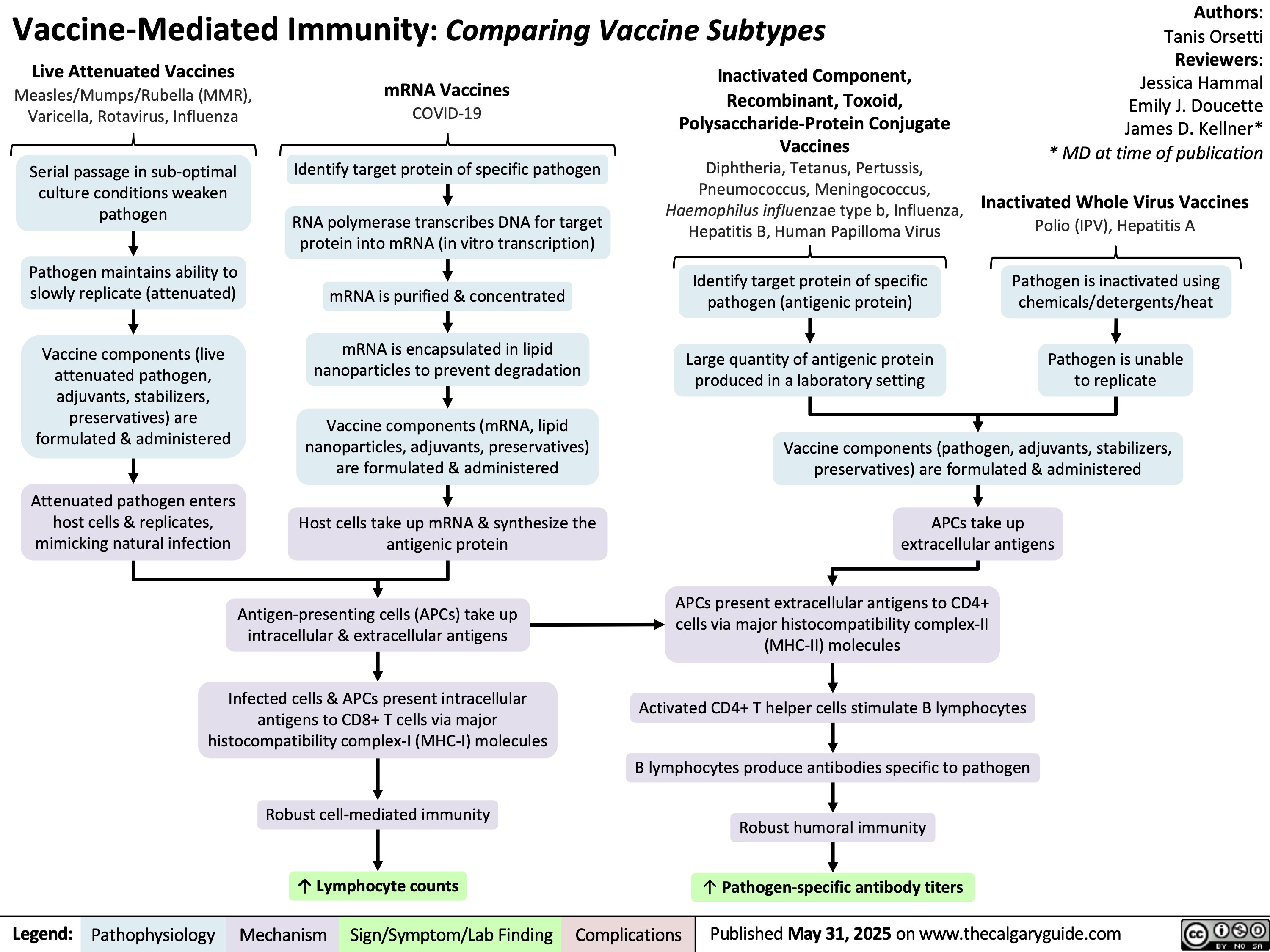
Vaccine Mediated Immunity Comparing Vaccine Subtypes

Vaccine-Mediated Immunity: Comparing Vaccine Subtypes
Live Attenuated Vaccines
mRNA Vaccines
Inactivated Component,
Recombinant, Toxoid,
Polysaccharide-Protein Conjugate
Vaccines
Measles/Mumps/Rubella (MMR),
Varicella, Rotavirus, Influenza
COVID-19
Serial passage in sub-optimal
culture conditions weaken
pathogen
Pathogen maintains ability to
slowly replicate (attenuated)
Vaccine components (live
attenuated pathogen,
adjuvants, stabilizers,
preservatives) are
formulated & administered
Attenuated pathogen enters
host cells & replicates,
mimicking natural infection
Identify target protein of specific pathogen
RNA polymerase transcribes DNA for target
protein into mRNA (in vitro transcription)
mRNA is purified & concentrated
mRNA is encapsulated in lipid
nanoparticles to prevent degradation
Vaccine components (mRNA, lipid
nanoparticles, adjuvants, preservatives)
are formulated & administered
Host cells take up mRNA & synthesize the
antigenic protein
Diphtheria, Tetanus, Pertussis,
Pneumococcus, Meningococcus,
Haemophilus influenzae type b, Influenza,
Hepatitis B, Human Papilloma Virus
Polio (IPV), Hepatitis A
Antigen-presenting cells (APCs) take up
intracellular & extracellular antigens
Infected cells & APCs present intracellular
antigens to CD8+ T cells via major
histocompatibility complex-I (MHC-I) molecules
Robust cell-mediated immunity
↑ Lymphocyte counts
Legend: Pathophysiology Mechanism
Sign/Symptom/Lab Finding Complications
Authors:
Tanis Orsetti
Reviewers:
Jessica Hammal
Emily J. Doucette
James D. Kellner*
* MD at time of publication
Inactivated Whole Virus Vaccines
Identify target protein of specific
pathogen (antigenic protein)
Pathogen is inactivated using
chemicals/detergents/heat
Large quantity of antigenic protein
produced in a laboratory setting
Pathogen is unable
to replicate
Vaccine components (pathogen, adjuvants, stabilizers,
preservatives) are formulated & administered
APCs take up
extracellular antigens
APCs present extracellular antigens to CD4+
cells via major histocompatibility complex-II
(MHC-II) molecules
Activated CD4+ T helper cells stimulate B lymphocytes
B lymphocytes produce antibodies specific to pathogen
Robust humoral immunity
↑ Pathogen-specific antibody titers
Published May 31, 2025 on www.thecalgaryguide.com

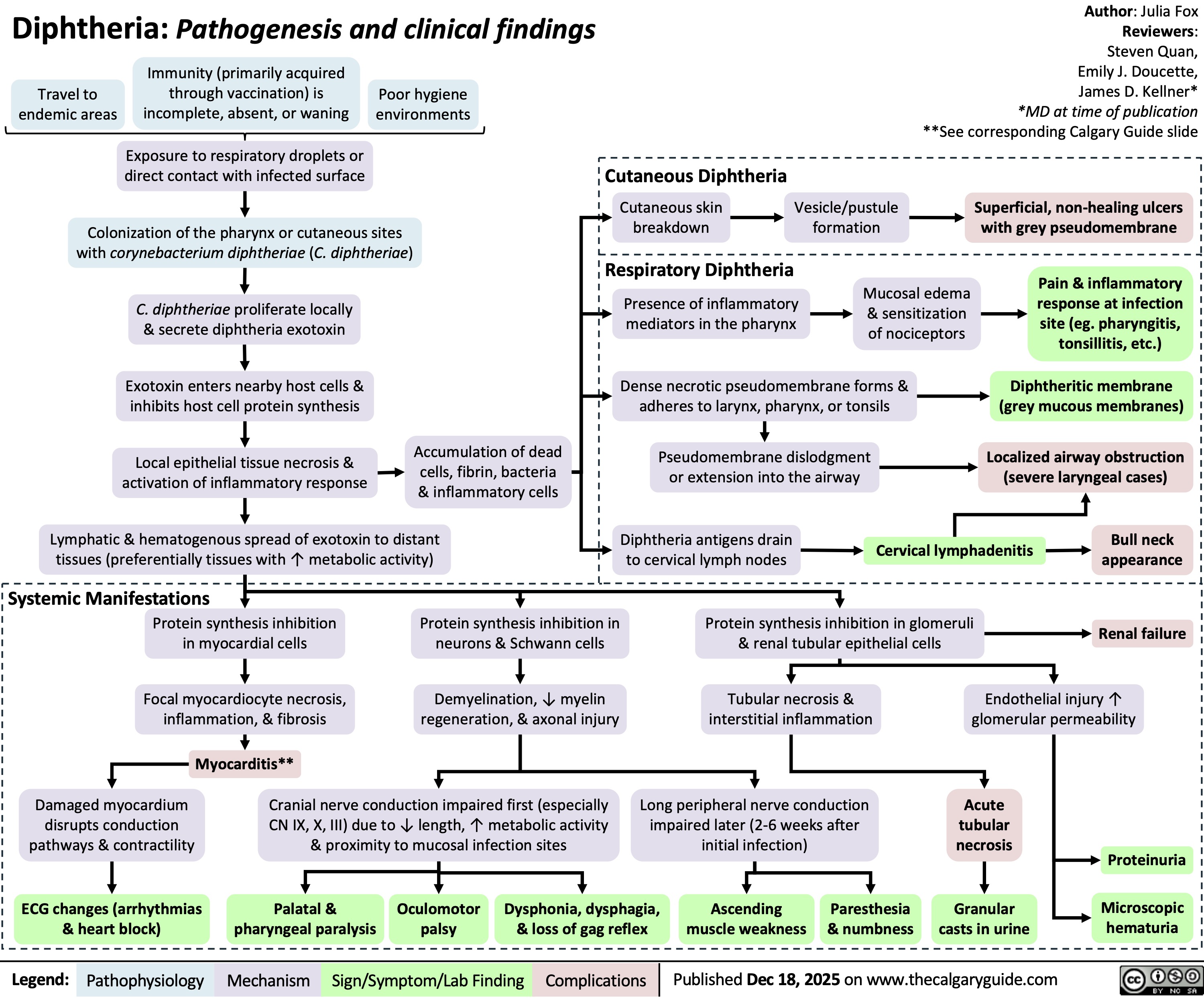
Diphtheria

Diphtheria: Pathogenesis and clinical findings
Travel to
endemic areas
Immunity (primarily acquired
through vaccination) is
incomplete, absent, or waning
Poor hygiene
environments
Exposure to respiratory droplets or
direct contact with infected surface
Colonization of the pharynx or cutaneous sites
with corynebacterium diphtheriae (C. diphtheriae)
C. diphtheriae proliferate locally
& secrete diphtheria exotoxin
Exotoxin enters nearby host cells &
inhibits host cell protein synthesis
Local epithelial tissue necrosis &
activation of inflammatory response
Accumulation of dead
cells, fibrin, bacteria
& inflammatory cells
Lymphatic & hematogenous spread of exotoxin to distant
tissues (preferentially tissues with ↑ metabolic activity)
Author: Julia Fox
Reviewers:
Steven Quan,
Emily J. Doucette,
James D. Kellner*
*MD at time of publication
**See corresponding Calgary Guide slide
Cutaneous Diphtheria
Cutaneous skin
breakdown
Vesicle/pustule
formation
Superficial, non-healing ulcers
with grey pseudomembrane
Respiratory Diphtheria
Presence of inflammatory
mediators in the pharynx
Mucosal edema
& sensitization
of nociceptors
Dense necrotic pseudomembrane forms &
adheres to larynx, pharynx, or tonsils
Pseudomembrane dislodgment
or extension into the airway
Diphtheria antigens drain
to cervical lymph nodes
Cervical lymphadenitis
Pain & inflammatory
response at infection
site (eg. pharyngitis,
tonsillitis, etc.)
Diphtheritic membrane
(grey mucous membranes)
Localized airway obstruction
(severe laryngeal cases)
Bull neck
appearance
Systemic Manifestations
Protein synthesis inhibition
in myocardial cells
Protein synthesis inhibition in
neurons & Schwann cells
Focal myocardiocyte necrosis,
inflammation, & fibrosis
Demyelination, ↓ myelin
regeneration, & axonal injury
Myocarditis**
Damaged myocardium
disrupts conduction
pathways & contractility
Cranial nerve conduction impaired first (especially
CN IX, X, III) due to ↓ length, ↑ metabolic activity
& proximity to mucosal infection sites
ECG changes (arrhythmias
& heart block)
Palatal &
pharyngeal paralysis
Oculomotor
palsy
Dysphonia, dysphagia,
& loss of gag reflex
Protein synthesis inhibition in glomeruli
& renal tubular epithelial cells
Tubular necrosis &
interstitial inflammation
Renal failure
Endothelial injury ↑
glomerular permeability
Long peripheral nerve conduction
impaired later (2-6 weeks after
initial infection)
Ascending
muscle weakness
Paresthesia
& numbness
Acute
tubular
necrosis
Granular
casts in urine
Proteinuria
Microscopic
hematuria
Legend: Pathophysiology Mechanism
Sign/Symptom/Lab Finding Complications
Published Dec 18, 2025 on www.thecalgaryguide.com

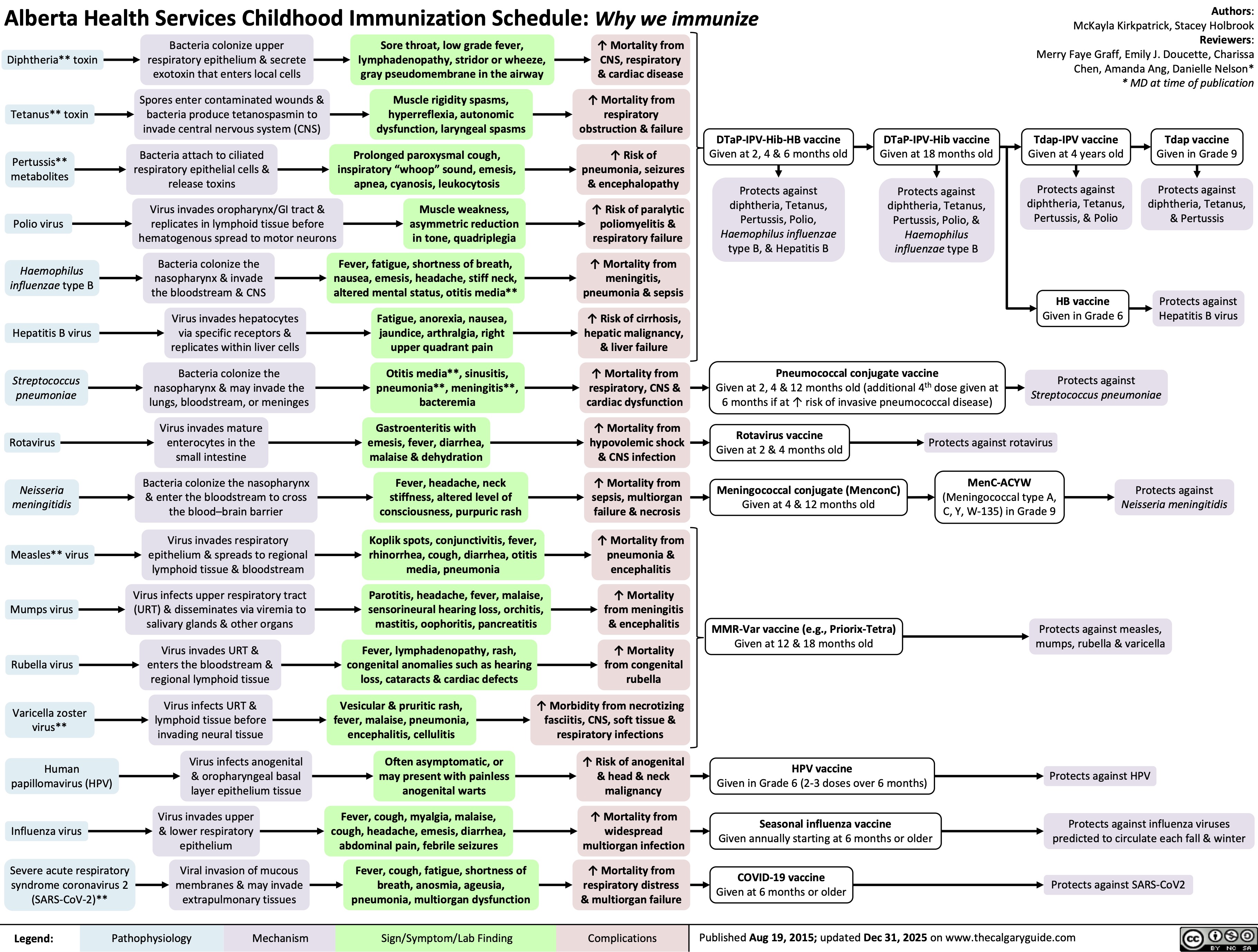
Childhood Immunization Schedule

Alberta Health Services Childhood Immunization Schedule: Why we immunize
Diphtheria** toxin
Bacteria colonize upper
respiratory epithelium & secrete
exotoxin that enters local cells
Sore throat, low grade fever,
lymphadenopathy, stridor or wheeze,
gray pseudomembrane in the airway
↑ Mortality from
CNS, respiratory
& cardiac disease
Tetanus** toxin
Pertussis**
metabolites
Polio virus
Haemophilus
influenzae type B
Hepatitis B virus
Streptococcus
pneumoniae
Rotavirus
Neisseria
meningitidis
Measles** virus
Mumps virus
Rubella virus
Varicella zoster
virus**
Human
papillomavirus (HPV)
Spores enter contaminated wounds &
bacteria produce tetanospasmin to
invade central nervous system (CNS)
Muscle rigidity spasms,
hyperreflexia, autonomic
dysfunction, laryngeal spasms
↑ Mortality from
respiratory
obstruction & failure
Bacteria attach to ciliated
respiratory epithelial cells &
release toxins
Prolonged paroxysmal cough,
inspiratory “whoop” sound, emesis,
apnea, cyanosis, leukocytosis
↑ Risk of
pneumonia, seizures
& encephalopathy
Virus invades oropharynx/GI tract &
replicates in lymphoid tissue before
hematogenous spread to motor neurons
↑ Risk of paralytic
poliomyelitis &
respiratory failure
Bacteria colonize the
nasopharynx & invade
the bloodstream & CNS
Virus invades hepatocytes
via specific receptors &
replicates within liver cells
Bacteria colonize the
nasopharynx & may invade the
lungs, bloodstream, or meninges
Virus invades mature
enterocytes in the
small intestine
Bacteria colonize the nasopharynx
& enter the bloodstream to cross
the blood–brain barrier
Virus invades respiratory
epithelium & spreads to regional
lymphoid tissue & bloodstream
Virus infects upper respiratory tract
(URT) & disseminates via viremia to
salivary glands & other organs
Virus invades URT &
enters the bloodstream &
regional lymphoid tissue
Virus infects URT &
lymphoid tissue before
invading neural tissue
Virus infects anogenital
& oropharyngeal basal
layer epithelium tissue
Influenza virus
Virus invades upper
& lower respiratory
epithelium
Severe acute respiratory
syndrome coronavirus 2
(SARS-CoV-2)**
Viral invasion of mucous
membranes & may invade
extrapulmonary tissues
Legend: Muscle weakness,
asymmetric reduction
in tone, quadriplegia
Fever, fatigue, shortness of breath,
nausea, emesis, headache, stiff neck,
altered mental status, otitis media**
Fatigue, anorexia, nausea,
jaundice, arthralgia, right
upper quadrant pain
Otitis media**, sinusitis,
pneumonia**, meningitis**,
bacteremia
Gastroenteritis with
emesis, fever, diarrhea,
malaise & dehydration
Fever, headache, neck
stiffness, altered level of
consciousness, purpuric rash
Koplik spots, conjunctivitis, fever,
rhinorrhea, cough, diarrhea, otitis
media, pneumonia
Parotitis, headache, fever, malaise,
sensorineural hearing loss, orchitis,
mastitis, oophoritis, pancreatitis
Fever, lymphadenopathy, rash,
congenital anomalies such as hearing
loss, cataracts & cardiac defects
↑ Mortality from
meningitis,
pneumonia & sepsis
↑ Risk of cirrhosis,
hepatic malignancy,
& liver failure
↑ Mortality from
respiratory, CNS &
cardiac dysfunction
↑ Mortality from
hypovolemic shock
& CNS infection
↑ Mortality from
sepsis, multiorgan
failure & necrosis
↑ Mortality from
pneumonia &
encephalitis
↑ Mortality
from meningitis
& encephalitis
↑ Mortality
from congenital
rubella
Vesicular & pruritic rash,
fever, malaise, pneumonia,
encephalitis, cellulitis
↑ Morbidity from necrotizing
fasciitis, CNS, soft tissue &
respiratory infections
Often asymptomatic, or
may present with painless
anogenital warts
↑ Risk of anogenital
& head & neck
malignancy
Fever, cough, myalgia, malaise,
cough, headache, emesis, diarrhea,
abdominal pain, febrile seizures
↑ Mortality from
widespread
multiorgan infection
Fever, cough, fatigue, shortness of
breath, anosmia, ageusia,
pneumonia, multiorgan dysfunction
↑ Mortality from
respiratory distress
& multiorgan failure
DTaP-IPV-Hib-HB vaccine
Given at 2, 4 & 6 months old
Protects against
diphtheria, Tetanus,
Pertussis, Polio,
Haemophilus influenzae
type B, & Hepatitis B
DTaP-IPV-Hib vaccine
Given at 18 months old
Protects against
diphtheria, Tetanus,
Pertussis, Polio, &
Haemophilus
influenzae type B
Pneumococcal conjugate vaccine
Given at 2, 4 & 12 months old (additional 4th dose given at
6 months if at ↑ risk of invasive pneumococcal disease)
Authors:
McKayla Kirkpatrick, Stacey Holbrook
Reviewers:
Merry Faye Graff, Emily J. Doucette, Charissa
Chen, Amanda Ang, Danielle Nelson*
* MD at time of publication
Tdap-IPV vaccine
Given at 4 years old
Tdap vaccine
Given in Grade 9
Protects against
diphtheria, Tetanus,
Pertussis, & Polio
Protects against
diphtheria, Tetanus,
& Pertussis
HB vaccine
Given in Grade 6
Protects against
Hepatitis B virus
Protects against
Streptococcus pneumoniae
Rotavirus vaccine
Given at 2 & 4 months old
Protects against rotavirus
Meningococcal conjugate (MenconC)
Given at 4 & 12 months old
MenC-ACYW
(Meningococcal type A,
C, Y, W-135) in Grade 9
Protects against
Neisseria meningitidis
MMR-Var vaccine (e.g., Priorix-Tetra)
Given at 12 & 18 months old
Protects against measles,
mumps, rubella & varicella
Pathophysiology Mechanism
Sign/Symptom/Lab Finding Complications
HPV vaccine
Given in Grade 6 (2-3 doses over 6 months)
Seasonal influenza vaccine
Given annually starting at 6 months or older
COVID-19 vaccine
Given at 6 months or older Published Aug 19, 2015; updated Dec 31, 2025 on www.thecalgaryguide.com
Protects against HPV
Protects against influenza viruses
predicted to circulate each fall & winter
Protects against SARS-CoV2

© 2026 - The Calgary Guide to Understanding Disease

Disclaimer