SEARCH RESULTS FOR: Cryoglobulinemia

Cryoglobulinemia
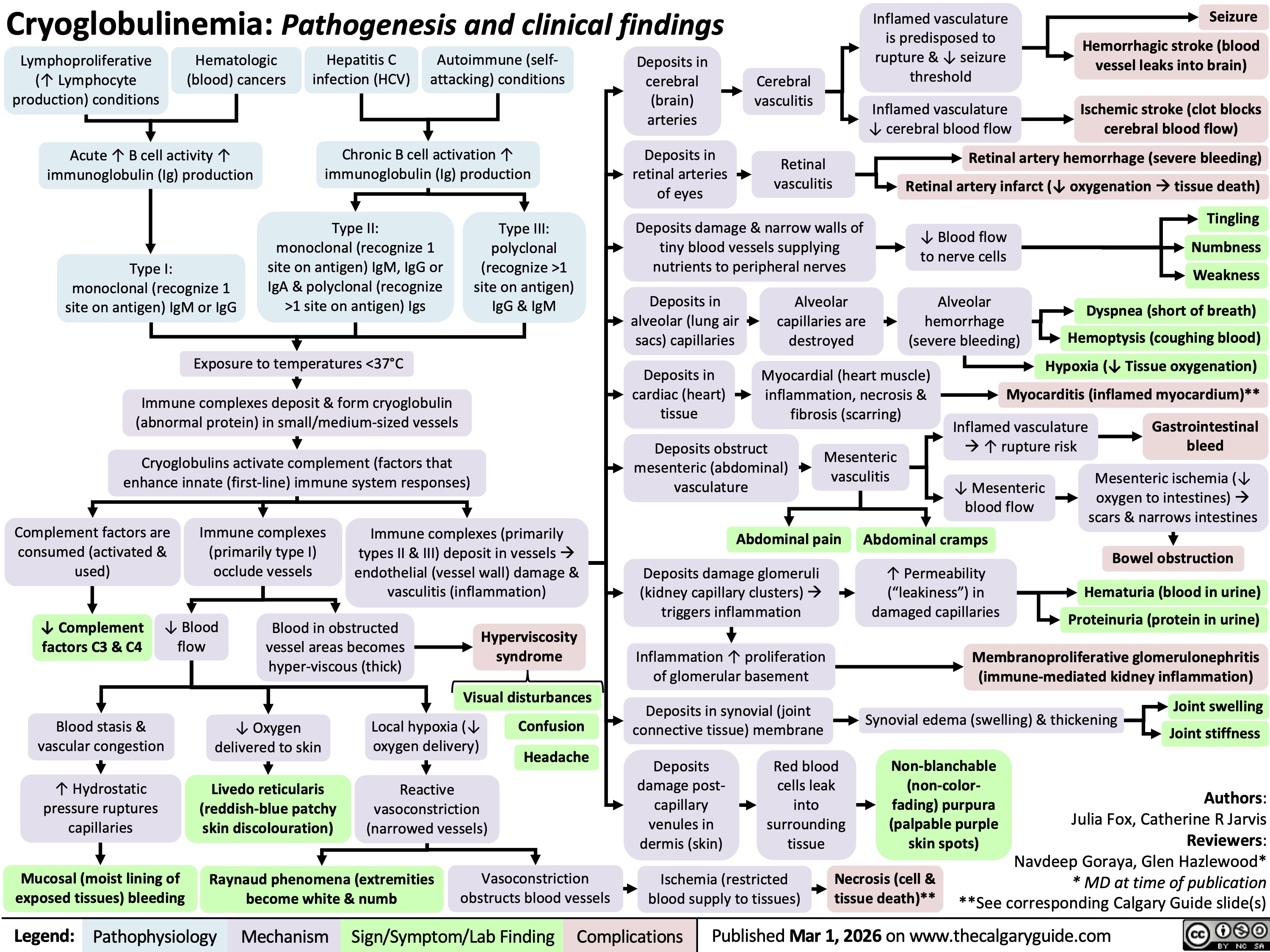
Cryoglobulinemia: Pathogenesis and clinical findings
Inflamed vasculature
Seizure
is predisposed to
Hemorrhagic stroke (blood
Lymphoproliferative
Hematologic
Hepatitis C
Autoimmune (self-
Deposits in
rupture & ↓ seizure
vessel leaks into brain)
(↑ Lymphocyte
(blood) cancers
infection (HCV)
attacking) conditions
cerebral
Cerebral
threshold
production) conditions
(brain)
vasculitis Ischemic stroke (clot blocks
Inflamed vasculature
arteries
↓ cerebral blood flow
cerebral blood flow)
Acute ↑ B cell activity ↑
Chronic B cell activation ↑
Deposits in
Retinal
Retinal artery hemorrhage (severe bleeding)
immunoglobulin (Ig) production
retinal arteries
vasculitis Retinal artery infarct (↓ oxygenation à tissue death)
of eyes
Tingling
Type II:
Type III:
Deposits damage & narrow walls of
↓ Blood flow
monoclonal (recognize 1
polyclonal
tiny blood vessels supplying
to nerve cells Numbness
Type I:
site on antigen) IgM, IgG or
(recognize >1
nutrients to peripheral nerves
Weakness
monoclonal (recognize 1
IgA & polyclonal (recognize
site on antigen)
site on antigen) IgM or IgG
>1 site on antigen) Igs
IgG & IgM
Deposits in
Alveolar
alveolar (lung air
capillaries are
sacs) capillaries
destroyed
Exposure to temperatures <37°C
Immune complexes deposit & form cryoglobulin
(abnormal protein) in small/medium-sized vessels
Cryoglobulins activate complement (factors that
enhance innate (first-line) immune system responses)
Deposits in
cardiac (heart)
tissue
Deposits obstruct
mesenteric (abdominal)
vasculature
Myocardial (heart muscle)
inflammation, necrosis &
fibrosis (scarring)
Mesenteric
vasculitis
Alveolar
Dyspnea (short of breath)
hemorrhage
(severe bleeding) Hemoptysis (coughing blood)
Hypoxia (↓ Tissue oxygenation)
Myocarditis (inflamed myocardium)**
Inflamed vasculature
Gastrointestinal
à ↑ rupture risk
bleed
Mesenteric ischemia (↓
↓ Mesenteric
blood flow
oxygen to intestines) à
scars & narrows intestines
Complement factors are
consumed (activated &
used)
Immune complexes
(primarily type I)
occlude vessels
Immune complexes (primarily
types II & III) deposit in vessels à
endothelial (vessel wall) damage &
vasculitis (inflammation)
Abdominal pain
Abdominal cramps
Bowel obstruction
Deposits damage glomeruli
(kidney capillary clusters) à
triggers inflammation
↑ Permeability
(“leakiness”) in
damaged capillaries
Hematuria (blood in urine)
Proteinuria (protein in urine)
↓ Complement
factors C3 & C4
Blood in obstructed
vessel areas becomes
hyper-viscous (thick)
Hyperviscosity
syndrome
Inflammation ↑ proliferation
of glomerular basement
Blood stasis &
vascular congestion
↓ Oxygen
delivered to skin
Local hypoxia (↓
oxygen delivery)
Visual disturbances
Confusion
Headache
Membranoproliferative glomerulonephritis
(immune-mediated kidney inflammation)
Joint swelling
Joint stiffness
↑ Hydrostatic
pressure ruptures
capillaries
Livedo reticularis
(reddish-blue patchy
skin discolouration)
Reactive
vasoconstriction
(narrowed vessels)
Deposits in synovial (joint
connective tissue) membrane Deposits
damage post-
capillary
venules in
dermis (skin)
Red blood
cells leak
into
surrounding
tissue
Mucosal (moist lining of
Raynaud phenomena (extremities
exposed tissues) bleeding
become white & numb
Vasoconstriction
obstructs blood vessels
Ischemia (restricted
blood supply to tissues)
Synovial edema (swelling) & thickening
Non-blanchable
(non-color-
fading) purpura
(palpable purple
skin spots)
Necrosis (cell &
tissue death)**
Authors:
Julia Fox, Catherine R Jarvis
Reviewers:
Navdeep Goraya, Glen Hazlewood*
* MD at time of publication
**See corresponding Calgary Guide slide(s)
Legend: Pathophysiology Mechanism
Complications
Published Mar 1, 2026 on www.thecalgaryguide.com
↓ Blood
flow
Sign/Symptom/Lab Finding