• Content
  • Collaboration
  • About Us
  • Contact Us

SEARCH RESULTS FOR: Chronic-Hypertensive-Retinopathy

chronic-hypertensive-retinopathy-pathogenesis-and-clinical-findings

Chronic Hypertensive Retinopathy: Pathogenesis and clinical findings 
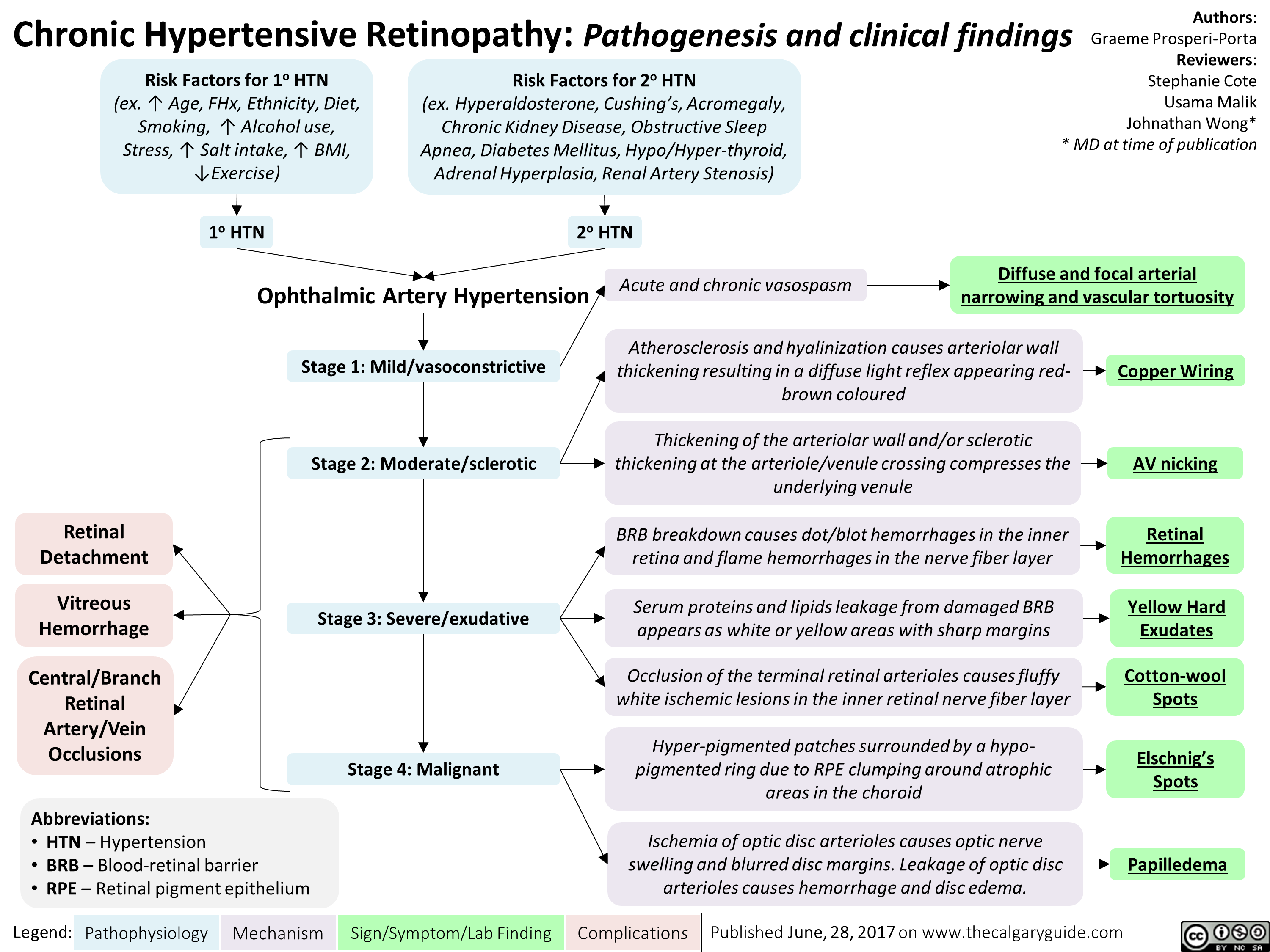
Risk Factors for 1° HTN (ex. 1` Age, FHx, Ethnicity, Diet, Smoking, 1` Alcohol use, Stress, 1` Salt intake, 1` BMI, 1, Exercise) • 1° HTN 
Retinal Detachment 
Vitreous Hemorrhage 
Central/Branch Retinal Artery/Vein Occlusions 
Risk Factors for 2° HTN (ex. Hyperaldosterone, Cushing's, Acromegaly, Chronic Kidney Disease, Obstructive Sleep Apnea, Diabetes Mellitus, Hypo/Hyper-thyroid, Adrenal Hyperplasia, Renal Artery Stenosis) 
2° HTN 
Ophthalmic Artery Hypertension ,17 
Stage 1: Mild/vasoconstrictive 
Stage 2: Moderate/sclerotic 
Stage 3: Severe/exudative 
Stage 4: Malignant 
Abbreviations: • HTN — Hypertension • BRB — Blood-retinal barrier • RPE — Retinal pigment epithelium 
Legend: 
Pathophysiology 
Mechanism 
Acute and chronic vasospasm 


Authors: Graeme Prosperi-Porta Reviewers: Stephanie Cote Usama Malik Johnathan Wong* * MD at time of publication 
Diffuse and focal arterial  narrowing and vascular tortuosity 
Atherosclerosis and hyalinization causes arteriolar wall thickening resulting in a diffuse light reflex appearing red-brown coloured 
Thickening of the arteriolar wall and/or sclerotic thickening at the arteriole/venule crossing compresses the underlying venule 
BRB breakdown causes dot/blot hemorrhages in the inner retina and flame hemorrhages in the nerve fiber layer 
Serum proteins and lipids leakage from damaged BRB appears as white or yellow areas with sharp margins 
Occlusion of the terminal retinal arterioles causes fluffy white ischemic lesions in the inner retinal nerve fiber layer 
Hyper-pigmented patches surrounded by a hypo-pigmented ring due to RPE clumping around atrophic areas in the choroid 
Sign/Symptom/Lab Finding 
lschemia of optic disc arterioles causes optic nerve swelling and blurred disc margins. Leakage of optic disc arterioles causes hemorrhage and disc edema. 
Complications 
Copper Wiring 
AV nicking 
Retinal  Hemorrhages 
Yellow Hard Exudates  
Cotton-wool Spots  
Elschnig's Spots  
Papilledema

Chronic Hypertensive Retinopathy

Stage 4:
Malignant
Fibrinoid necrosis of choroidal
arterioles & choroidal lobule ischemia
↓ Perfusion to choriocapillaris
Optic disc arteriole ischemia **See corresponding Calgary Guide Side
Legend: Pathophysiology Sign/Symptom/Lab Finding
Chronic Hypertensive Retinopathy: Pathogenesis and clinical findings
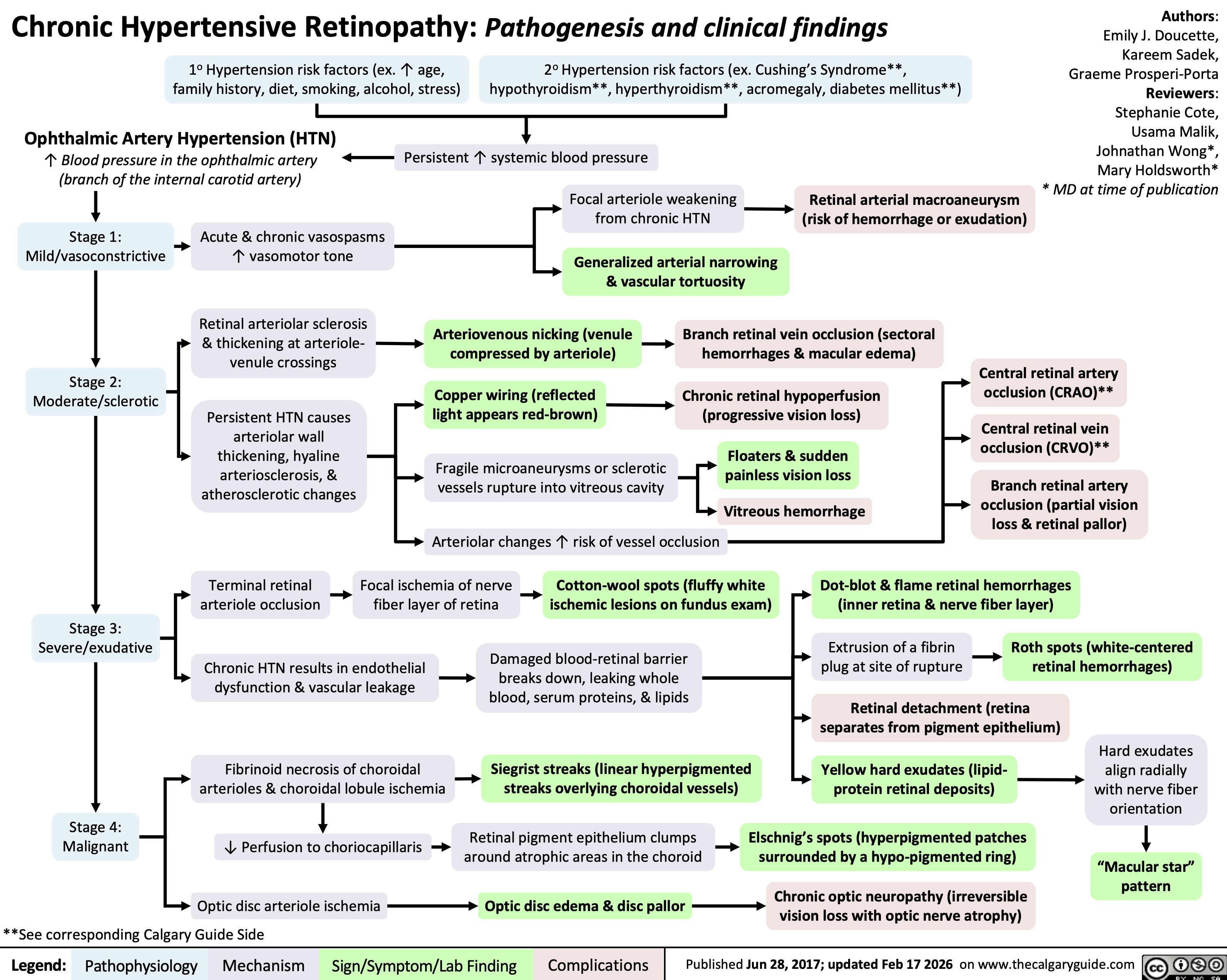
1o Hypertension risk factors (ex. ↑ age,
family history, diet, smoking, alcohol, stress)
2o Hypertension risk factors (ex. Cushing’s Syndrome**,
hypothyroidism**, hyperthyroidism**, acromegaly, diabetes mellitus**)
Ophthalmic Artery Hypertension (HTN)
↑ Blood pressure in the ophthalmic artery
(branch of the internal carotid artery)
Persistent ↑ systemic blood pressure
Authors:
Emily J. Doucette,
Kareem Sadek,
Graeme Prosperi-Porta
Reviewers:
Stephanie Cote,
Usama Malik,
Johnathan Wong*,
Mary Holdsworth*
* MD at time of publication
Stage 1:
Mild/vasoconstrictive
Stage 2:
Moderate/sclerotic
Stage 3:
Severe/exudative
Focal arteriole weakening
from chronic HTN
Retinal arterial macroaneurysm
(risk of hemorrhage or exudation)
Acute & chronic vasospasms
↑ vasomotor tone
Generalized arterial narrowing
& vascular tortuosity
Retinal arteriolar sclerosis
& thickening at arteriole-
venule crossings
Arteriovenous nicking (venule
compressed by arteriole)
Branch retinal vein occlusion (sectoral
hemorrhages & macular edema)
Central retinal artery
occlusion (CRAO)**
Copper wiring (reflected
light appears red-brown)
Chronic retinal hypoperfusion
(progressive vision loss)
Persistent HTN causes
arteriolar wall
thickening, hyaline
arteriosclerosis, &
atherosclerotic changes
Central retinal vein
occlusion (CRVO)**
Fragile microaneurysms or sclerotic
vessels rupture into vitreous cavity
Floaters & sudden
painless vision loss
Vitreous hemorrhage
Branch retinal artery
occlusion (partial vision
loss & retinal pallor)
Arteriolar changes ↑ risk of vessel occlusion
Terminal retinal
arteriole occlusion
Focal ischemia of nerve
fiber layer of retina
Cotton-wool spots (fluffy white
ischemic lesions on fundus exam)
Dot-blot & flame retinal hemorrhages
(inner retina & nerve fiber layer)
Chronic HTN results in endothelial
dysfunction & vascular leakage
Damaged blood-retinal barrier
breaks down, leaking whole
blood, serum proteins, & lipids
Extrusion of a fibrin
plug at site of rupture
Roth spots (white-centered
retinal hemorrhages)
Retinal detachment (retina
separates from pigment epithelium)
Siegrist streaks (linear hyperpigmented
streaks overlying choroidal vessels)
Yellow hard exudates (lipid-
protein retinal deposits)
Hard exudates
align radially
with nerve fiber
orientation
Retinal pigment epithelium clumps
around atrophic areas in the choroid
Elschnig’s spots (hyperpigmented patches
surrounded by a hypo-pigmented ring)
“Macular star”
pattern
Optic disc edema & disc pallor
Chronic optic neuropathy (irreversible
vision loss with optic nerve atrophy)
Published Jun 28, 2017; updated Feb 17 2026 on www.thecalgaryguide.com
Mechanism Complications

© 2026 - The Calgary Guide to Understanding Disease

Disclaimer