SEARCH RESULTS FOR: Bullous-Pemphigoid

Bullous Pemphigoid
Bullous Pemphigoid: Pathogenesis and clinical findings
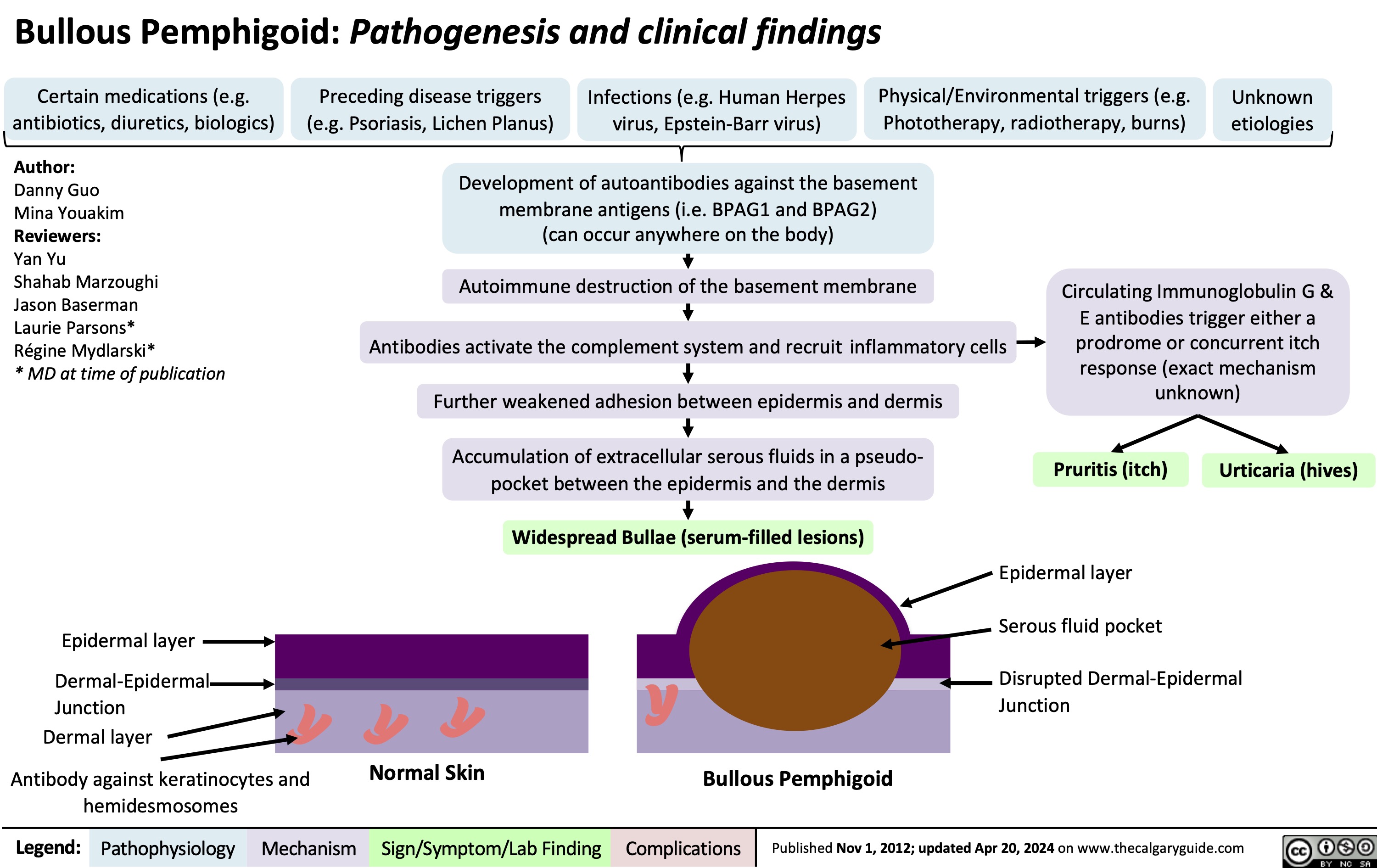
     Certain medications (e.g. antibiotics, diuretics, biologics)
Author:
Danny Guo
Mina Youakim
Reviewers:
Yan Yu
Shahab Marzoughi
Jason Baserman
Laurie Parsons*
Régine Mydlarski*
* MD at time of publication
Preceding disease triggers Infections (e.g. Human Herpes Physical/Environmental triggers (e.g. (e.g. Psoriasis, Lichen Planus) virus, Epstein-Barr virus) Phototherapy, radiotherapy, burns)
Development of autoantibodies against the basement membrane antigens (i.e. BPAG1 and BPAG2) (can occur anywhere on the body)
Autoimmune destruction of the basement membrane
Antibodies activate the complement system and recruit inflammatory cells Further weakened adhesion between epidermis and dermis
Accumulation of extracellular serous fluids in a pseudo- pocket between the epidermis and the dermis
Unknown etiologies
    Circulating Immunoglobulin G & E antibodies trigger either a prodrome or concurrent itch response (exact mechanism unknown)
       Pruritis (itch)
Epidermal layer Serous fluid pocket
Urticaria (hives)
 Widespread Bullae (serum-filled lesions)
  Epidermal layer
Dermal-Epidermal
Junction Dermal layer
Antibody against keratinocytes and
Disrupted Dermal-Epidermal Junction
    Y
   hemidesmosomes
Normal Skin
Bullous Pemphigoid
 Legend:
 Pathophysiology
 Mechanism
Sign/Symptom/Lab Finding
 Complications
 Published Nov 1, 2012; updated Apr 20, 2024 on www.thecalgaryguide.com
 Y Y
Y