SEARCH RESULTS FOR: Brachial-Plexus

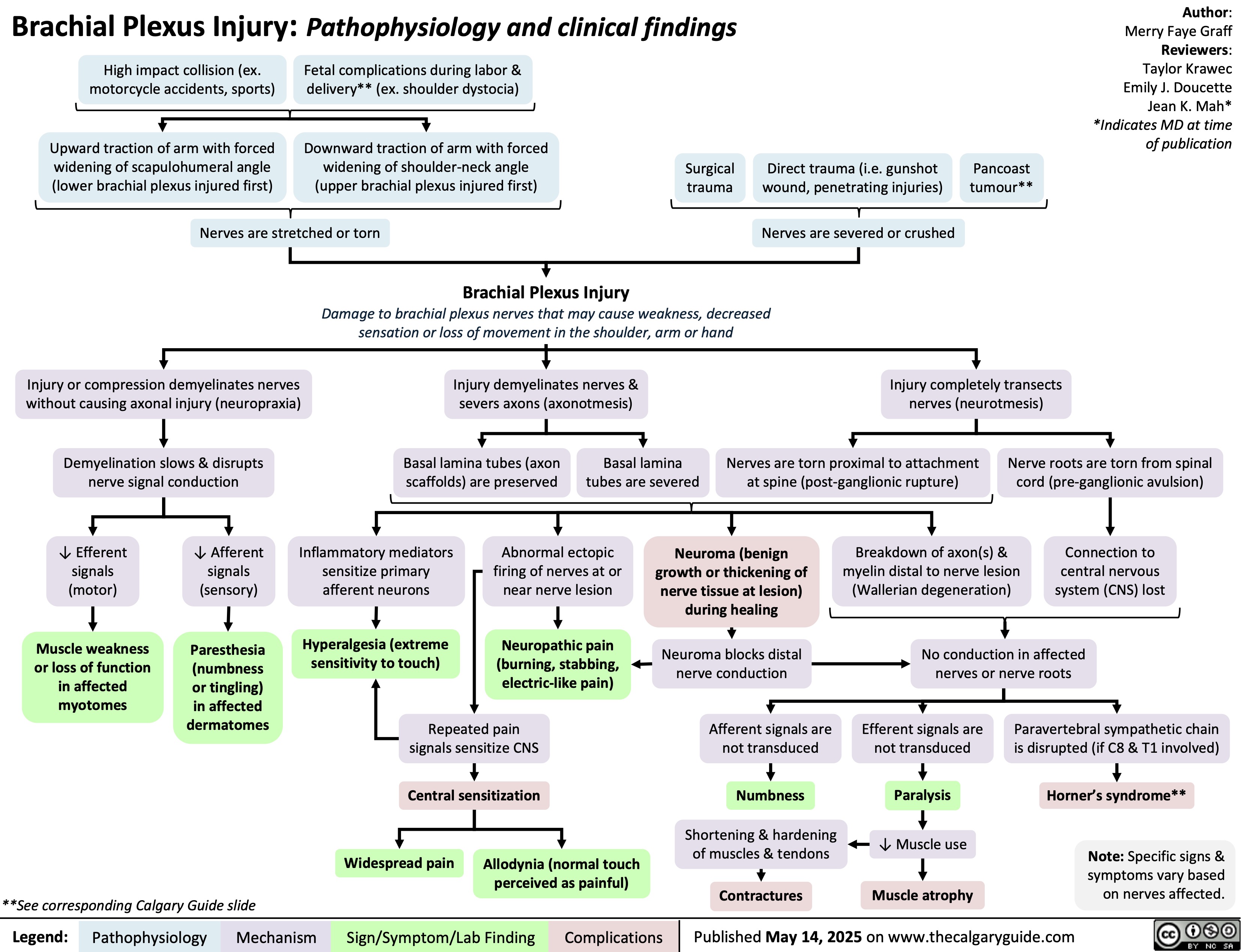
Brachial Plexus Injury

**See corresponding Calgary Guide slide
Legend: Brachial Plexus Injury: Pathophysiology and clinical findings
High impact collision (ex.
motorcycle accidents, sports)
Fetal complications during labor &
delivery** (ex. shoulder dystocia)
Author:
Merry Faye Graff
Reviewers:
Taylor Krawec
Emily J. Doucette
Jean K. Mah*
*Indicates MD at time
of publication
Upward traction of arm with forced
widening of scapulohumeral angle
(lower brachial plexus injured first)
Downward traction of arm with forced
widening of shoulder-neck angle
(upper brachial plexus injured first)
Surgical
trauma
Direct trauma (i.e. gunshot
wound, penetrating injuries)
Pancoast
tumour**
Nerves are stretched or torn
Nerves are severed or crushed
Brachial Plexus Injury
Damage to brachial plexus nerves that may cause weakness, decreased
sensation or loss of movement in the shoulder, arm or hand
Injury or compression demyelinates nerves
without causing axonal injury (neuropraxia)
Injury demyelinates nerves &
severs axons (axonotmesis)
Injury completely transects
nerves (neurotmesis)
Demyelination slows & disrupts
nerve signal conduction
Basal lamina tubes (axon
scaffolds) are preserved
Basal lamina
tubes are severed
Nerves are torn proximal to attachment
at spine (post-ganglionic rupture)
Nerve roots are torn from spinal
cord (pre-ganglionic avulsion)
↓ Efferent
signals
(motor)
↓ Afferent
signals
(sensory)
Inflammatory mediators
sensitize primary
afferent neurons
Abnormal ectopic
firing of nerves at or
near nerve lesion
Neuroma (benign
growth or thickening of
nerve tissue at lesion)
during healing
Breakdown of axon(s) &
myelin distal to nerve lesion
(Wallerian degeneration)
Connection to
central nervous
system (CNS) lost
Muscle weakness
or loss of function
in affected
myotomes
Paresthesia
(numbness
or tingling)
in affected
dermatomes
Hyperalgesia (extreme
sensitivity to touch)
Neuropathic pain
(burning, stabbing,
electric-like pain)
Neuroma blocks distal
nerve conduction
No conduction in affected
nerves or nerve roots
Repeated pain
signals sensitize CNS
Afferent signals are
not transduced
Efferent signals are
not transduced
Paravertebral sympathetic chain
is disrupted (if C8 & T1 involved)
Central sensitization
Numbness
Paralysis
Horner’s syndrome**
Shortening & hardening
of muscles & tendons
↓ Muscle use
Widespread pain
Allodynia (normal touch
perceived as painful)
Contractures
Muscle atrophy
Note: Specific signs &
symptoms vary based
on nerves affected.
Complications
Published May 14, 2025 on www.thecalgaryguide.com
Pathophysiology Mechanism
Sign/Symptom/Lab Finding

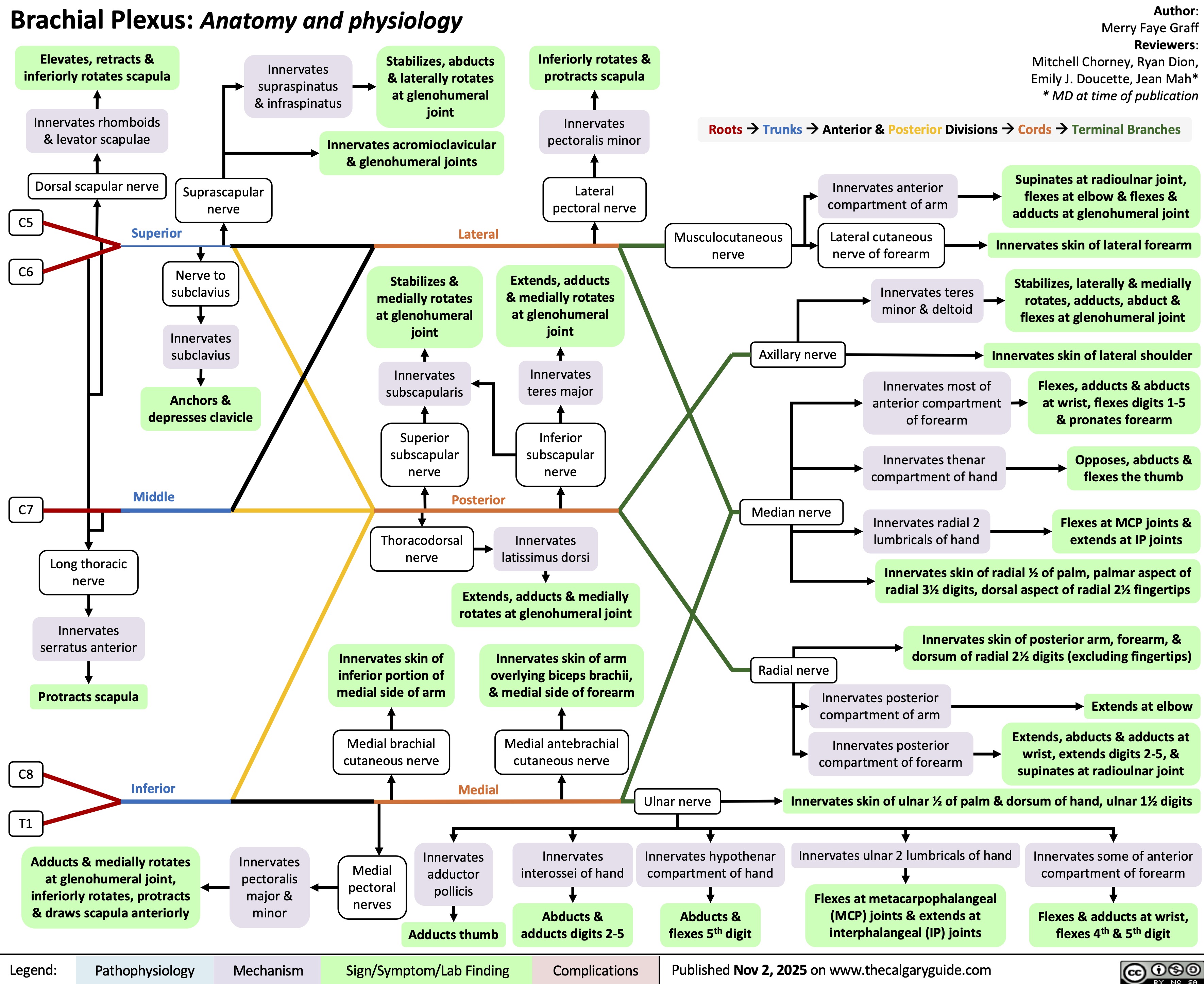
Brachial Plexus

Brachial Plexus: Anatomy and physiology Elevates, retracts &
inferiorly rotates scapula
Innervates
supraspinatus
& infraspinatus
Stabilizes, abducts
& laterally rotates
at glenohumeral
joint
Inferiorly rotates &
protracts scapula
Innervates rhomboids
& levator scapulae
Dorsal scapular nerve
Suprascapular
nerve
C5
Superior
C6
Nerve to
subclavius
Innervates
subclavius
Anchors &
depresses clavicle
Middle
C7
Long thoracic
nerve
Innervates
serratus anterior
Protracts scapula
C8
Inferior
T1
Innervates
pectoralis minor
Innervates acromioclavicular
& glenohumeral joints
Lateral
pectoral nerve
Lateral
Stabilizes &
medially rotates
at glenohumeral
joint
Extends, adducts
& medially rotates
at glenohumeral
joint
Innervates
subscapularis
Innervates
teres major
Superior
subscapular
nerve
Inferior
subscapular
nerve
Posterior
Thoracodorsal
nerve
Innervates
latissimus dorsi
Extends, adducts & medially
rotates at glenohumeral joint
Innervates skin of
inferior portion of
medial side of arm
Innervates skin of arm
overlying biceps brachii,
& medial side of forearm
Medial brachial
cutaneous nerve
Medial antebrachial
cutaneous nerve
Medial
Adducts & medially rotates
at glenohumeral joint,
inferiorly rotates, protracts
& draws scapula anteriorly
Innervates
pectoralis
major &
minor
Medial
pectoral
nerves
Innervates
adductor
pollicis
Innervates
interossei of hand
Adducts thumb
Abducts &
adducts digits 2-5
Legend: Pathophysiology Mechanism
Sign/Symptom/Lab Finding Complications
Author:
Merry Faye Graff
Reviewers:
Mitchell Chorney, Ryan Dion,
Emily J. Doucette, Jean Mah*
* MD at time of publication
Roots à Trunks à Anterior & Posterior Divisions à Cords à Terminal Branches
Innervates anterior
compartment of arm
Supinates at radioulnar joint,
flexes at elbow & flexes &
adducts at glenohumeral joint
Musculocutaneous
nerve
Lateral cutaneous
nerve of forearm
Innervates skin of lateral forearm
Innervates teres
minor & deltoid
Stabilizes, laterally & medially
rotates, adducts, abduct &
flexes at glenohumeral joint
Axillary nerve
Innervates skin of lateral shoulder
Innervates most of
anterior compartment
of forearm
Flexes, adducts & abducts
at wrist, flexes digits 1-5
& pronates forearm
Innervates thenar
compartment of hand
Opposes, abducts &
flexes the thumb
Median nerve
Innervates radial 2
lumbricals of hand
Flexes at MCP joints &
extends at IP joints
Innervates skin of radial ½ of palm, palmar aspect of
radial 3½ digits, dorsal aspect of radial 2½ fingertips
Innervates skin of posterior arm, forearm, &
dorsum of radial 2½ digits (excluding fingertips)
Radial nerve
Innervates posterior
compartment of arm Innervates posterior
compartment of forearm
Extends at elbow
Extends, abducts & adducts at
wrist, extends digits 2-5, &
supinates at radioulnar joint
Ulnar nerve
Innervates skin of ulnar ½ of palm & dorsum of hand, ulnar 1½ digits
Innervates hypothenar
compartment of hand
Innervates ulnar 2 lumbricals of hand
Innervates some of anterior
compartment of forearm
Abducts &
flexes 5th digit
Flexes at metacarpophalangeal
(MCP) joints & extends at
interphalangeal (IP) joints
Flexes & adducts at wrist,
flexes 4th & 5th digit
Published Nov 2, 2025 on www.thecalgaryguide.com