SEARCH RESULTS FOR: Bilirubin-Metabolism

Bilirubin Metabolism
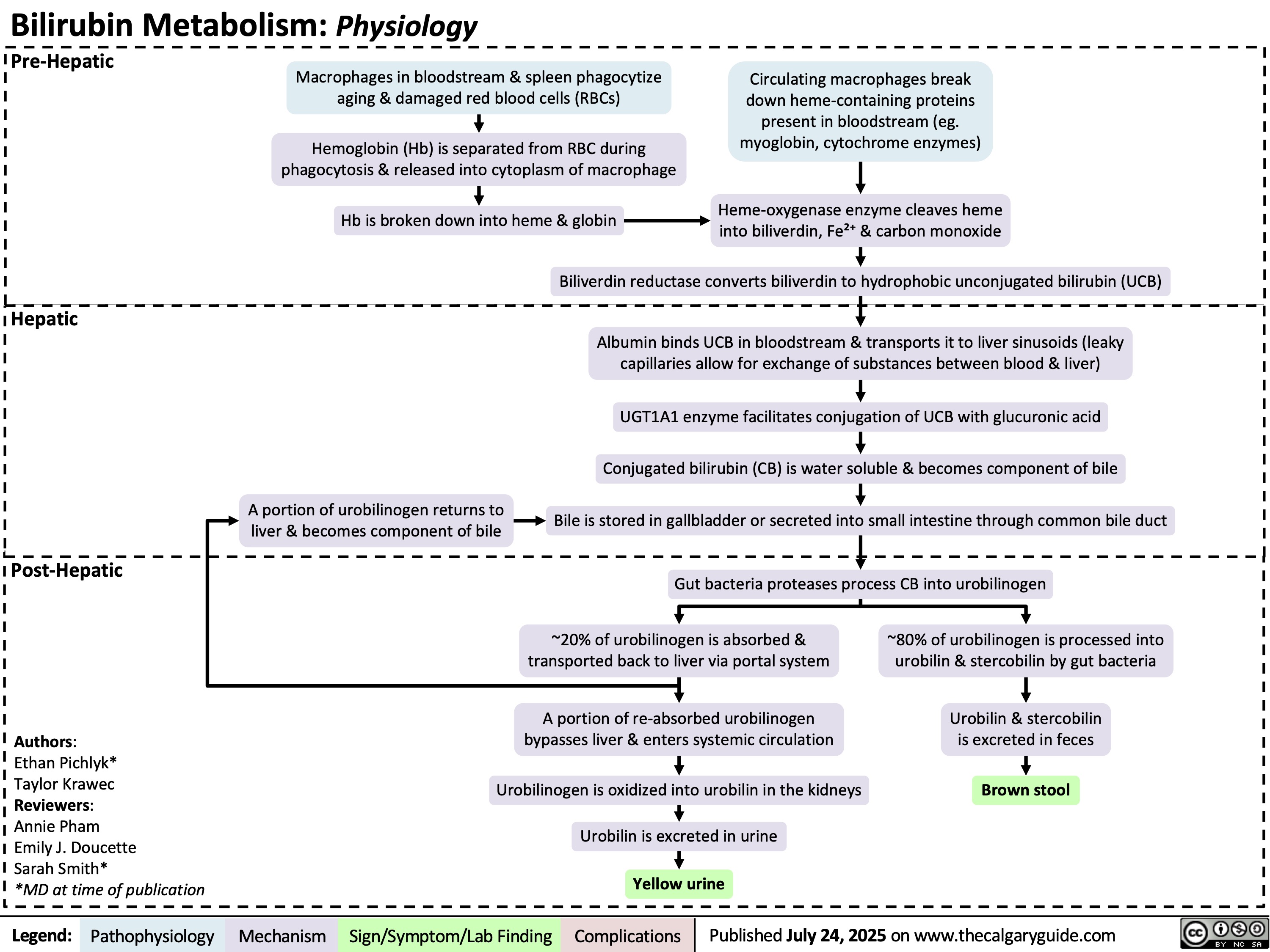
Bilirubin Metabolism: Physiology
Pre-Hepatic
Macrophages in bloodstream & spleen phagocytize
aging & damaged red blood cells (RBCs)
Hemoglobin (Hb) is separated from RBC during
phagocytosis & released into cytoplasm of macrophage
Hb is broken down into heme & globin
Circulating macrophages break
down heme-containing proteins
present in bloodstream (eg.
myoglobin, cytochrome enzymes)
Heme-oxygenase enzyme cleaves heme
into biliverdin, Fe²⁺ & carbon monoxide
Biliverdin reductase converts biliverdin to hydrophobic unconjugated bilirubin (UCB)
Hepatic
Albumin binds UCB in bloodstream & transports it to liver sinusoids (leaky
capillaries allow for exchange of substances between blood & liver)
UGT1A1 enzyme facilitates conjugation of UCB with glucuronic acid
Conjugated bilirubin (CB) is water soluble & becomes component of bile
A portion of urobilinogen returns to
liver & becomes component of bile
Bile is stored in gallbladder or secreted into small intestine through common bile duct
Post-Hepatic
Gut bacteria proteases process CB into urobilinogen
~20% of urobilinogen is absorbed &
transported back to liver via portal system
~80% of urobilinogen is processed into
urobilin & stercobilin by gut bacteria
A portion of re-absorbed urobilinogen
bypasses liver & enters systemic circulation
Urobilin & stercobilin
is excreted in feces
Authors:
Ethan Pichlyk*
Taylor Krawec
Reviewers:
Annie Pham
Emily J. Doucette
Sarah Smith*
*MD at time of publication
Legend: Pathophysiology Urobilinogen is oxidized into urobilin in the kidneys
Urobilin is excreted in urine
Yellow urine
Brown stool
Mechanism
Sign/Symptom/Lab Finding Complications
Published July 24, 2025 on www.thecalgaryguide.com