SEARCH RESULTS FOR: Autism-Spectrum-Disorder

Autism Spectrum Disorder
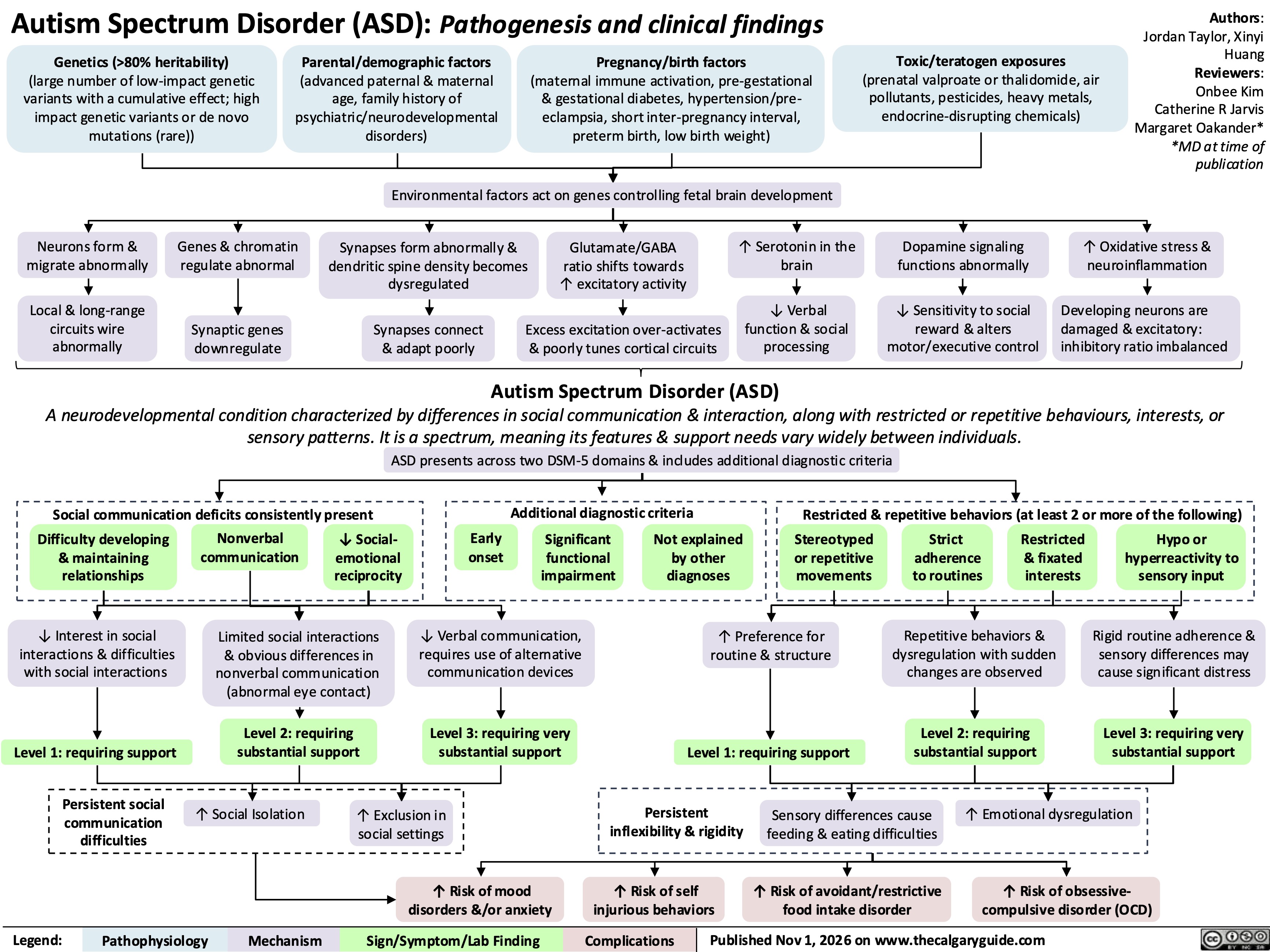
Toxic/teratogen exposures
(prenatal valproate or thalidomide, air
pollutants, pesticides, heavy metals,
endocrine-disrupting chemicals)
Neurons form &
migrate abnormally
Local & long-range
circuits wire
abnormally
Autism Spectrum Disorder (ASD): Pathogenesis and clinical findings
Genetics (>80% heritability)
(large number of low-impact genetic
variants with a cumulative effect; high
impact genetic variants or de novo
mutations (rare))
Parental/demographic factors
(advanced paternal & maternal
age, family history of
psychiatric/neurodevelopmental
disorders)
Pregnancy/birth factors
(maternal immune activation, pre-gestational
& gestational diabetes, hypertension/pre-
eclampsia, short inter-pregnancy interval,
preterm birth, low birth weight)
Environmental factors act on genes controlling fetal brain development
Genes & chromatin
regulate abnormal
Synapses form abnormally &
dendritic spine density becomes
dysregulated
Glutamate/GABA
ratio shifts towards
V activity
VVVV
brain
Dopamine signaling
functions abnormally
VOxidative stress &
neuroinflammation
Synaptic genes
downregulate
Synapses connect
& adapt poorly
Excess excitation over-activates
& poorly tunes cortical circuits
SS
function & social
processing
SSSS
reward & alters
motor/executive control
Developing neurons are
damaged & excitatory:
inhibitory ratio imbalanced
Autism Spectrum Disorder (ASD)
A neurodevelopmental condition characterized by differences in social communication & interaction, along with restricted or repetitive behaviours, interests, or
sensory patterns. It is a spectrum, meaning its features & support needs vary widely between individuals.
Social communication deficits consistently present Additional diagnostic criteria
Difficulty developing
Nonverbal
& maintaining
communication
Social-
Early
Significant
Not explained
Stereotyped
emotional
onset
functional
by other
or repetitive
relationships
reciprocity
impairment
diagnoses
movements
Limited social interactions
& obvious differences in
nonverbal communication
(abnormal eye contact)
VVV
Preference for
requires use of alternative
routine & structure
communication devices
Level 2: requiring
substantial support
VSocial Isolation VExclusion in
social settings
ASD presents across two DSM-5 domains & includes additional diagnostic criteria
Restricted & repetitive behaviors (at least 2 or more of the following)
Strict
adherence
to routines
Restricted
& fixated
interests
Hypo or
hyperreactivity to
sensory input
Repetitive behaviors &
cause significant distress
Rigid routine adherence &
dysregulation with sudden
sensory differences may
changes are observed
Level 3: requiring very
substantial support
Level 1: requiring support
Level 2: requiring
substantial support
Level 3: requiring very
substantial support
Persistent
Sensory differences cause
inflexibility & rigidity
feeding & eating difficulties
V/VV
disorders &/or anxiety
injurious behaviors
food intake disorder
-
compulsive disorder (OCD)
Authors:
Jordan Taylor, Xinyi
Huang
Reviewers:
Onbee Kim
Catherine R Jarvis
Margaret Oakander*
*MD at time of
publication
VVVV
interactions & difficulties
with social interactions
Level 1: requiring support
Persistent social
communication
difficulties
Legend: Pathophysiology Mechanism
Sign/Symptom/Lab Finding Complications
Published Nov 1, 2026 on www.thecalgaryguide.com
Creative
Commons