SEARCH RESULTS FOR: Apert-Syndrome

Apert Syndrome
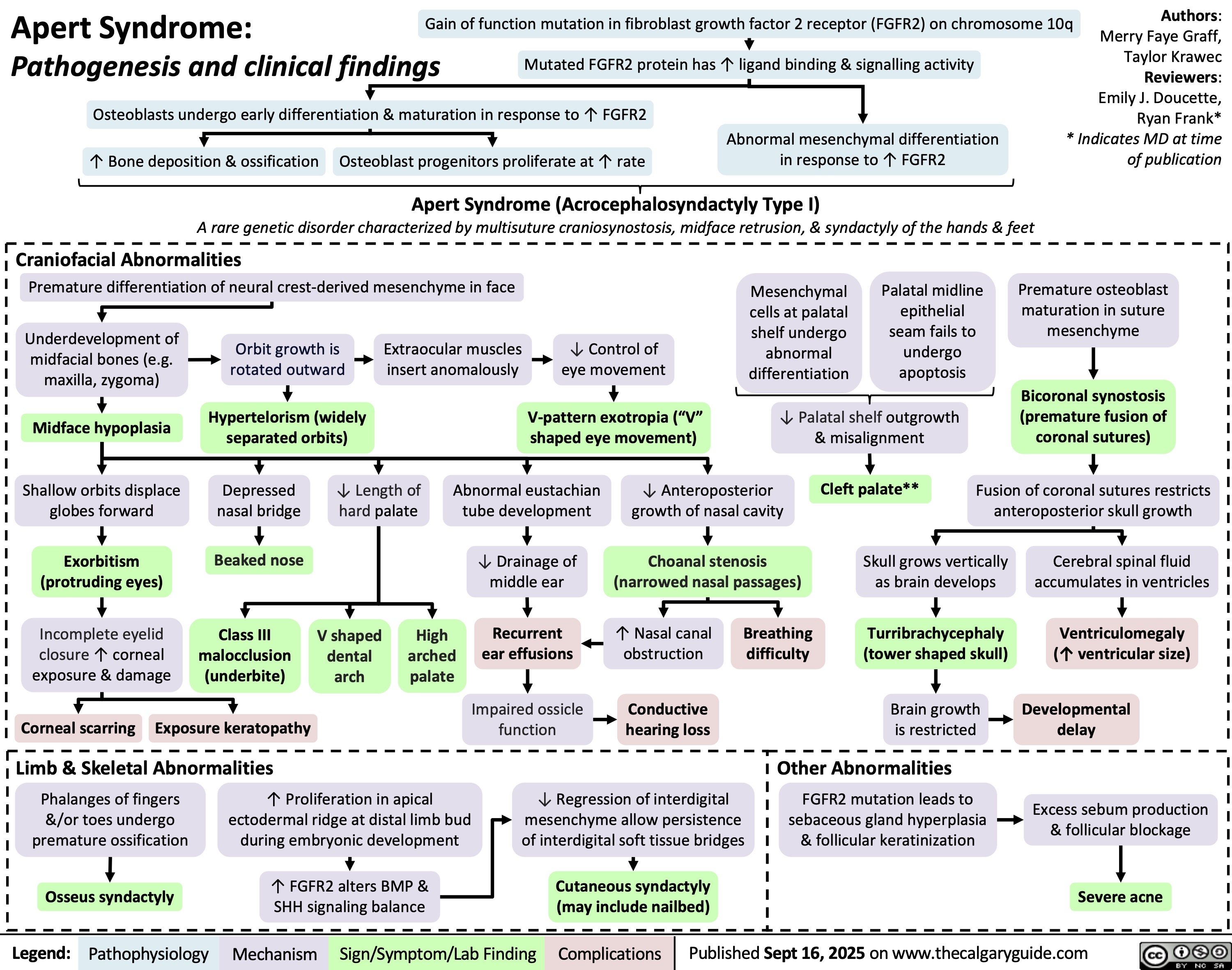
Apert Syndrome:
Pathogenesis and clinical findings
Gain of function mutation in fibroblast growth factor 2 receptor (FGFR2) on chromosome 10q
Mutated FGFR2 protein has ↑ ligand binding & signalling activity
Osteoblasts undergo early differentiation & maturation in response to ↑ FGFR2
↑ Bone deposition & ossification
Osteoblast progenitors proliferate at ↑ rate
Abnormal mesenchymal differentiation
in response to ↑ FGFR2
Authors:
Merry Faye Graff,
Taylor Krawec
Reviewers:
Emily J. Doucette,
Ryan Frank*
* Indicates MD at time
of publication
Apert Syndrome (Acrocephalosyndactyly Type I)
A rare genetic disorder characterized by multisuture craniosynostosis, midface retrusion, & syndactyly of the hands & feet
Craniofacial Abnormalities
Premature differentiation of neural crest-derived mesenchyme in face
Underdevelopment of
midfacial bones (e.g.
maxilla, zygoma)
Orbit growth is
rotated outward
Extraocular muscles
insert anomalously
↓ Control of
eye movement
Mesenchymal
cells at palatal
shelf undergo
abnormal
differentiation
Palatal midline
epithelial
seam fails to
undergo
apoptosis
Premature osteoblast
maturation in suture
mesenchyme
Midface hypoplasia
Hypertelorism (widely
separated orbits)
V-pattern exotropia (“V”
shaped eye movement)
↓ Palatal shelf outgrowth
& misalignment
Bicoronal synostosis
(premature fusion of
coronal sutures)
Shallow orbits displace
globes forward
Depressed
nasal bridge
↓ Length of
hard palate
Abnormal eustachian
tube development
↓ Anteroposterior
growth of nasal cavity
Cleft palate**
Fusion of coronal sutures restricts
anteroposterior skull growth
Exorbitism
(protruding eyes)
Beaked nose
↓ Drainage of
middle ear
Choanal stenosis
(narrowed nasal passages)
Skull grows vertically
as brain develops
Cerebral spinal fluid
accumulates in ventricles
Incomplete eyelid
closure ↑ corneal
exposure & damage
Class III
malocclusion
(underbite)
V shaped
dental
arch
High
arched
palate
Recurrent
ear effusions
↑ Nasal canal
obstruction
Breathing
difficulty
Turribrachycephaly
(tower shaped skull)
Ventriculomegaly
(↑ ventricular size)
Corneal scarring
Exposure keratopathy
Impaired ossicle
function
Conductive
hearing loss
Brain growth
is restricted
Developmental
delay
Limb & Skeletal Abnormalities
Phalanges of fingers
&/or toes undergo
premature ossification
↑ Proliferation in apical
ectodermal ridge at distal limb bud
during embryonic development
↓ Regression of interdigital
mesenchyme allow persistence
of interdigital soft tissue bridges
Other Abnormalities
FGFR2 mutation leads to
sebaceous gland hyperplasia
& follicular keratinization
Excess sebum production
& follicular blockage
Osseus syndactyly
Legend: ↑ FGFR2 alters BMP &
SHH signaling balance
Pathophysiology Mechanism
Sign/Symptom/Lab Finding Cutaneous syndactyly
(may include nailbed)
Severe acne
Published Sept 16, 2025 on www.thecalgaryguide.com
Complications