SEARCH RESULTS FOR: Acute-Compartment-Syndrome

Acute Compartment Syndrome
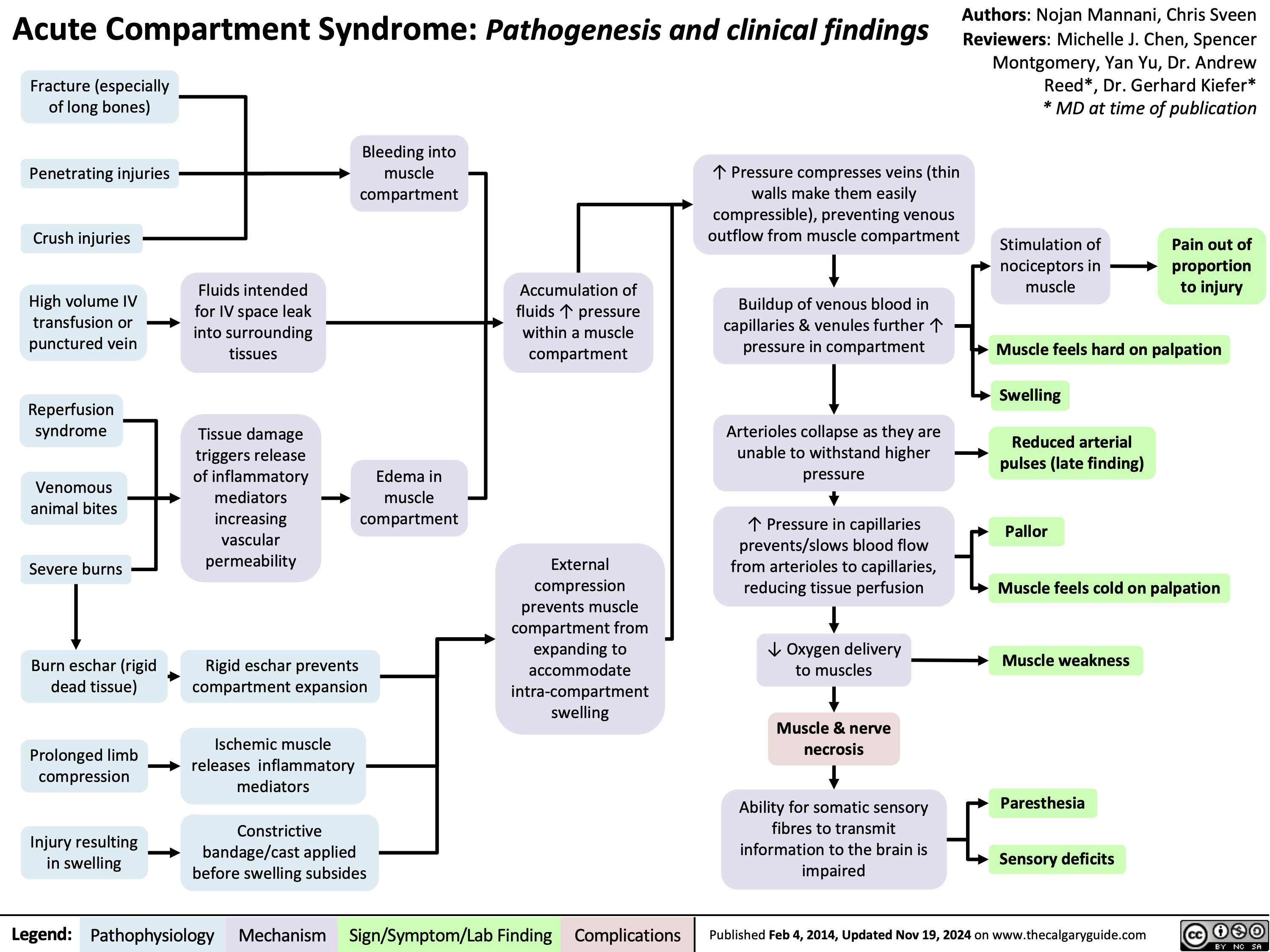
Acute Compartment Syndrome: Pathogenesis and clinical findings Fracture (especially
Authors: Nojan Mannani, Chris Sveen Reviewers: Michelle J. Chen, Spencer Montgomery, Yan Yu, Dr. Andrew Reed*, Dr. Gerhard Kiefer* * MD at time of publication
  of long bones) Penetrating injuries
Crush injuries
High volume IV transfusion or punctured vein
Reperfusion syndrome
Venomous animal bites
Severe burns
Burn eschar (rigid dead tissue)
Prolonged limb compression
Injury resulting in swelling
Bleeding into muscle compartment
↑ Pressure compresses veins (thin walls make them easily compressible), preventing venous outflow from muscle compartment
Buildup of venous blood in capillaries & venules further ↑ pressure in compartment
Arterioles collapse as they are unable to withstand higher pressure
↑ Pressure in capillaries prevents/slows blood flow from arterioles to capillaries, reducing tissue perfusion
↓ Oxygen delivery to muscles
Muscle & nerve necrosis
Ability for somatic sensory fibres to transmit information to the brain is impaired
            Fluids intended for IV space leak into surrounding tissues
Tissue damage triggers release of inflammatory mediators increasing vascular permeability
Accumulation of fluids ↑ pressure within a muscle compartment
Stimulation of nociceptors in muscle
Pain out of proportion to injury
             Edema in muscle compartment
Muscle feels hard on palpation Swelling
Reduced arterial pulses (late finding)
Pallor
Muscle feels cold on palpation
Muscle weakness
Paresthesia Sensory deficits
              Rigid eschar prevents compartment expansion
Ischemic muscle releases inflammatory mediators
Constrictive bandage/cast applied before swelling subsides
External compression prevents muscle compartment from expanding to accommodate intra-compartment swelling
          Legend:
 Pathophysiology
Mechanism
Sign/Symptom/Lab Finding
 Complications
 Published Feb 4, 2014, Updated Nov 19, 2024 on www.thecalgaryguide.com